After an FND diagnosis, the next question quickly arises: and what helps now? The good news first – FND is, in principle, reversible, because it is not the structure of the nervous system that is damaged, but its interplay that is disrupted. And interplay can be re-trained.1 There is no standard recipe that fits everyone: FND presents very differently – from weakness and paralysis through movement disorders and functional seizures to speech and voice problems. That is why treatment is tailored to the particular symptoms.
The essentials
- There is no single standard therapy – treatment is tailored to the symptoms.
- A well-explained, positively made diagnosis is itself the first step of treatment.
- The best-studied building blocks are physiotherapy (for movement symptoms) and psychotherapy / CBT (including for functional seizures).
- For speech and voice symptoms, specialised speech and language therapy helps; in everyday life, often occupational therapy.
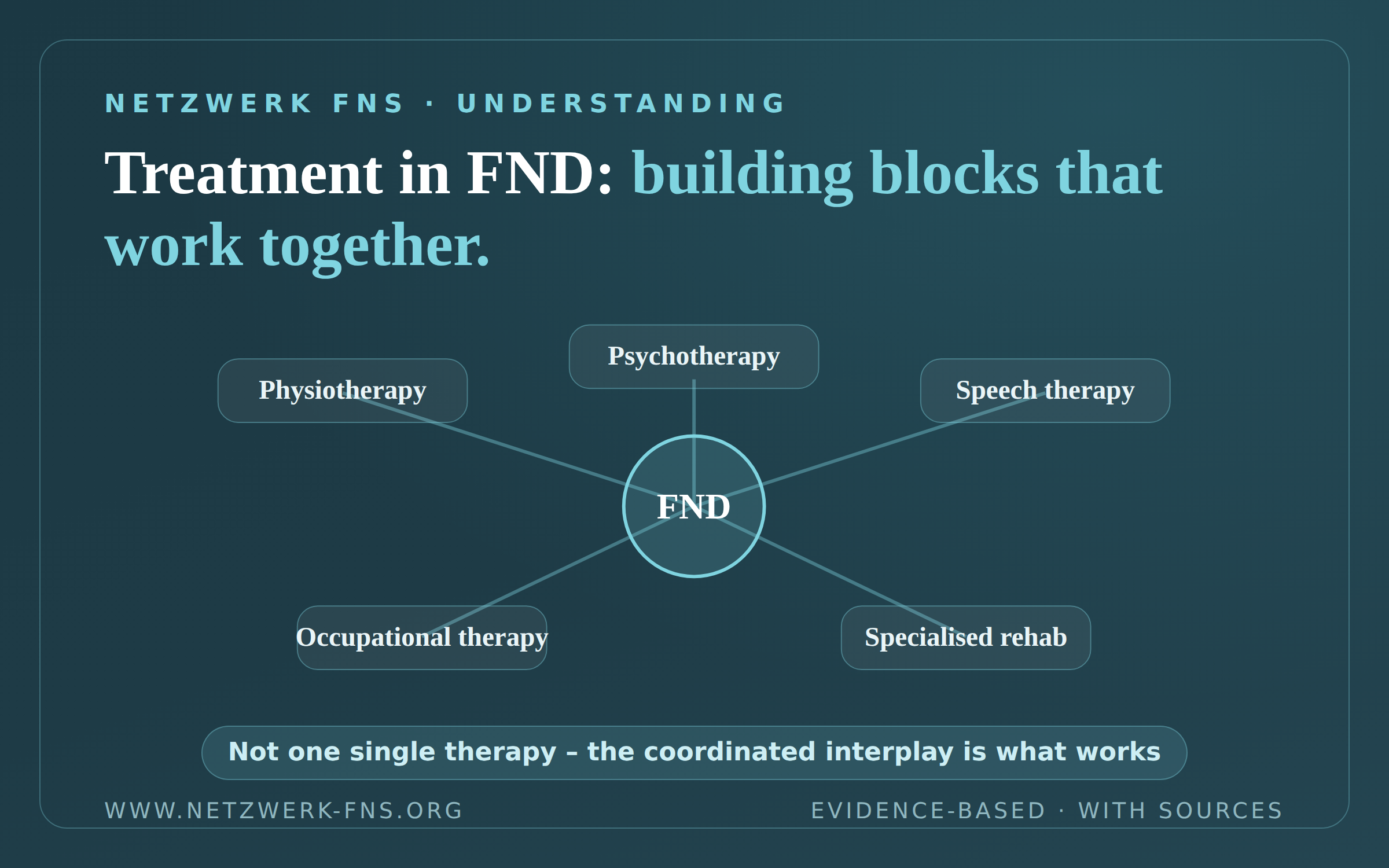
- Most effective is usually a coordinated, multimodal approach – several disciplines pulling together.
- It matters that the practitioners have experience with FND.
The diagnosis is the first step of treatment
In FND, treatment does not begin only with the first therapy session, but already with the diagnosis itself. Experts agree: a positively made diagnosis, clearly explained and demonstrated with clinical signs, is a treatment factor in its own right.1,7 Those who understand what FND is and why the symptoms are real can end the wearing search for the “missing finding” – and free up energy for what helps. That is exactly why a good explanation is an inseparable part of the therapy and not a mere preliminary. How the diagnosis is made and where FND comes from is covered under “Causes & diagnosis”.
Physiotherapy – re-training movement
For functional movement symptoms – paralysis, weakness, tremor, gait and standing problems – physiotherapy tailored to FND is a central building block. It differs from classic rehabilitation: instead of training strength and endurance, the aim is to rediscover automatic movement and to release the excessive self-monitoring that blocks movement. International experts have formulated their own consensus recommendations for this.2 The evidence is still developing: a large trial (Physio4FMD, 2024) could not confirm, in its primary outcome, the hoped-for clear advantage of specialised physiotherapy over usual referral – probably in part because the comparison group was already treated by FND-experienced clinicians.3 Overarching analyses still see moderate improvements in movement symptoms through physiotherapy.6 In practice, what matters most is that the physiotherapists are familiar with FND.
Psychotherapy and cognitive behavioural therapy
Psychotherapy in FND does not mean that the symptoms are “imagined”. It addresses how tension, attention, earlier experiences and physical reactions interact – and how this cycle can be influenced. The best-studied approach is cognitive behavioural therapy (CBT), especially for dissociative (functional) seizures. The large CODES trial showed that, while CBT did not reduce seizure frequency alone more than good standard care, it brought advantages in several other areas – quality of life, functioning, satisfaction.4 Overarching analyses see the most consistent benefit from CBT when it is embedded in a coordinated, multimodal treatment concept.6 Which form of psychotherapy fits depends on the symptoms and the life situation.
Speech and language therapy – functional speech and voice disorders
FND can also appear as a functional speech, voice or swallowing disorder – for example as sudden stammering, an altered voice, whispered speech, or a feeling of tightness in the throat. Here, specialised speech and language therapy helps: not speech exercises as after a stroke, but techniques that re-establish automatic, unimpeded speech and voice production. For this, too, there are dedicated international consensus recommendations for speech and language therapy.5
Occupational therapy and the way back into everyday life
While physiotherapy works on movement itself, occupational therapy helps to manage symptoms in everyday life: breaking tasks down so they succeed, using distraction strategies in daily activity, and regaining work, household and participation step by step. Especially with long-standing or multi-layered symptoms, this practical, everyday-oriented approach is a valuable building block in the overall concept.
Specialised rehabilitation – when several threads come together
With pronounced or long-standing symptoms, a setting in which several disciplines work together under one roof is often sensible – inpatient or day-patient in a clinic experienced with FND. The greatest benefit rarely comes from a single building block, but from the coordinated interplay: shared explanation of the diagnosis, physiotherapy, psychotherapeutic support and, where needed, speech and occupational therapy mesh together.1,6 In Germany, the guideline of the German Society of Neurology likewise recommends such a multimodal, individually coordinated approach.7
Are there medications for FND?
A common and understandable question – and the honest answer is: there is no medication that treats the Functional Neurological Disorder itself. Because in FND there is no structural damage, but a disruption of the interplay within the nervous system, there is no drug that directly “removes” the symptoms. The load-bearing pillars of treatment are therefore physiotherapy, psychotherapy and the other building blocks named above, not tablets.1,7
Medication can, however, be useful alongside – namely when there are additional complaints that respond well to treatment: for example depression, an anxiety or sleep disorder, migraine or chronic pain. When these are eased, coping with FND often becomes easier too. But this is to be distinguished from treating the FND itself. Whether and which medications fit in an individual case belongs in medical hands.
What you can do yourself
Treatment is not a one-way street – much can also be supported by yourself. Reliable, well-prepared information about FND helps you understand the condition and apply distraction and movement strategies in everyday life; an internationally established resource for this is neurosymptoms.org by neurologists around Jon Stone.8 Just as important: keeping a realistic, patient outlook. Improvement in FND rarely runs in a straight line – setbacks are part of it and do not mean the treatment isn’t working. And you do not have to walk the path alone: exchange with other people affected and contact with FND-experienced professionals take much of the burden out of the uncertainty.
Read on
How FND develops over time is covered in “Prognosis in FND”. Why an endless search for causes can itself become a burden is shown by “The Spiral”. And how dissociation and functional seizures are connected is explained in “Dissociation”.
Sources
- Espay AJ, Aybek S, Carson A, et al. Current Concepts in Diagnosis and Treatment of Functional Neurological Disorders. JAMA Neurology. 2018;75(9):1132–1141. doi:10.1001/jamaneurol.2018.1264. PMID 29868890.
- Nielsen G, Stone J, Matthews A, et al. Physiotherapy for functional motor disorders: a consensus recommendation. Journal of Neurology, Neurosurgery & Psychiatry. 2015;86(10):1113–1119. doi:10.1136/jnnp-2014-309255. PMID 25433033.
- Nielsen G, Stone J, Lee TC, et al. Specialist physiotherapy for functional motor disorder in England and Scotland (Physio4FMD): a pragmatic, multicentre, phase 3 randomised controlled trial. The Lancet Neurology. 2024;23(7):675–686. doi:10.1016/S1474-4422(24)00135-2. PMID 38768621.
- Goldstein LH, Robinson EJ, Mellers JDC, et al. Cognitive behavioural therapy for adults with dissociative seizures (CODES): a pragmatic, multicentre, randomised controlled trial. The Lancet Psychiatry. 2020;7(6):491–505. doi:10.1016/S2215-0366(20)30128-0. PMID 32445688.
- Baker J, Barnett C, Cavalli L, et al. Management of functional communication, swallowing, cough and related disorders: consensus recommendations for speech and language therapy. Journal of Neurology, Neurosurgery & Psychiatry. 2021;92(10):1112–1125. doi:10.1136/jnnp-2021-326767. PMID 34210802.
- Mavroudis I, Petrides F, Franekova K, et al. Treatment of functional neurological disorder: an umbrella review of systematic reviews and meta-analyses. Journal of Neurology. 2025;272:710. doi:10.1007/s00415-025-13449-7.
- Deutsche Gesellschaft für Neurologie (DGN). S2k guideline “Functional Movement Disorders”, AWMF register 030/148, 2026.
- Stone J, et al. Functional neurological disorder – patient information. neurosymptoms.org (accessed 2026).
This article does not replace medical or therapeutic advice. Which treatment fits in an individual case is always decided together with FND-experienced professionals.