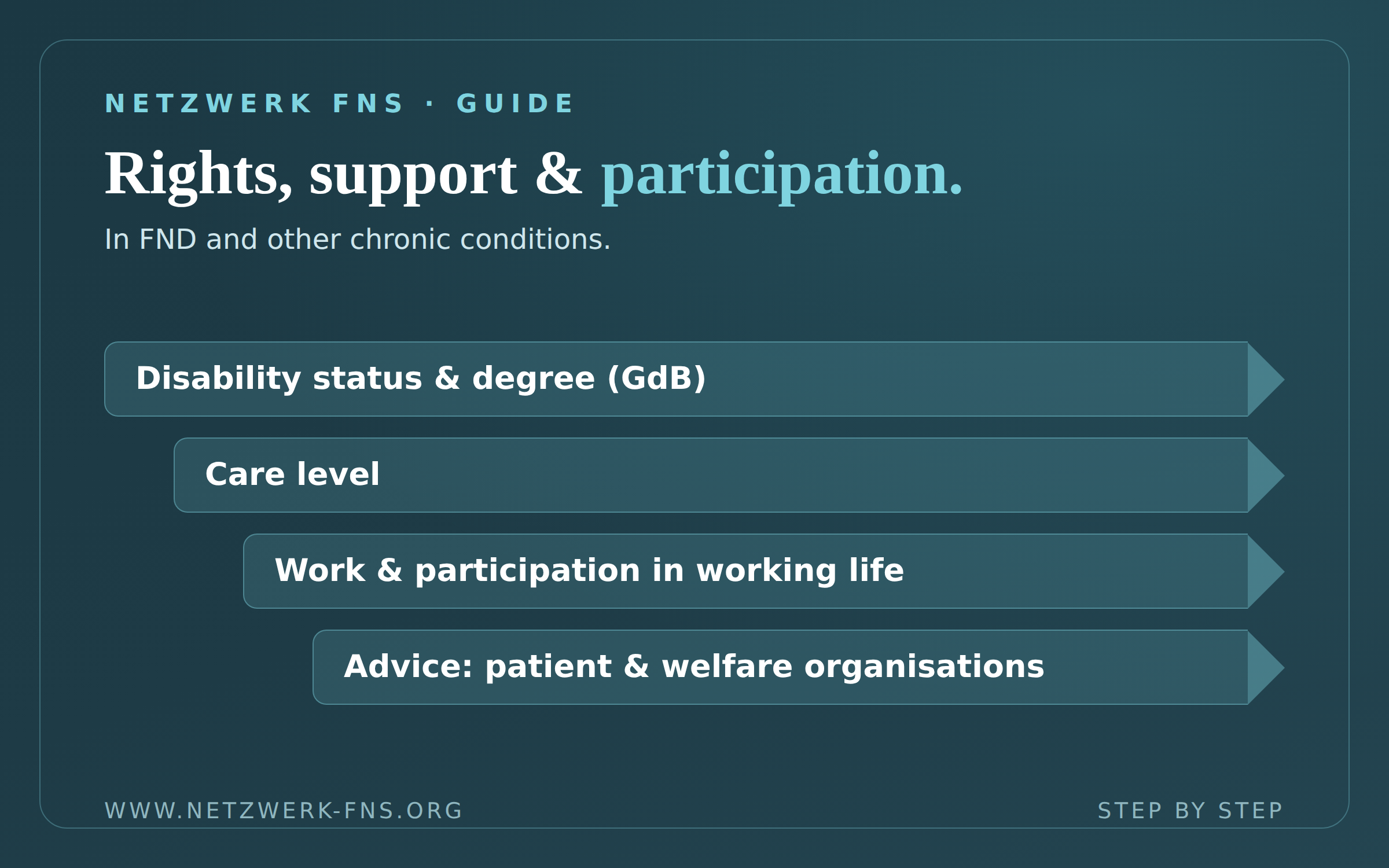
Many of those affected at some point face questions such as: am I entitled to a disability card? Can I apply for a care level? What becomes of my job? And who helps me through the “bureaucracy jungle”? This guide gives first orientation. It does not replace legal or social advice, but shows whom you can turn to. The following describes the German system; if you are elsewhere, your national disability and patient organisations are the place to start.
Severe disability & degree of disability (GdB)
How strongly a condition affects participation is expressed as the degree of disability (Grad der Behinderung, GdB) – from 20 to 100. From a GdB of 50, one is considered severely disabled and receives a severe-disability card, which enables various compensations for disadvantage (e.g. special protection against dismissal, additional leave, tax advantages, and depending on the marks also concessions in local transport).
You submit the application to the office responsible for your federal state – usually the Versorgungsamt or the state office for social affairs (the name differs by federal state). The basis of the assessment is the “Versorgungsmedizinische Grundsätze”, the so-called GdS/GdB table (annex to § 2 of the Versorgungsmedizin-Verordnung). There it is laid down how individual impairments are assessed. To the GdS/GdB table ↗
Care level (Pflegegrad) – when support in everyday life becomes necessary
If regular help is needed in everyday life, a care level (Pflegegrad) (1 to 5) can additionally be applied for – independently of the GdB. The procedure differs by insurance:
Those with statutory insurance submit the application informally to their care insurance fund (Pflegekasse) (it is located with the health insurance fund). The Medical Service (MD) then assesses the care needs – usually during a home visit.
Those with private insurance turn to their private compulsory care insurance. The assessment is done here by MEDICPROOF, the medical service of the private insurers. The assessment criteria are the same as for the statutory funds. medicproof.de ↗
Work & participation in working life
A condition often also brings professional cuts with it. But there are many forms of support to stay in work or gain a foothold again:
The German Pension Insurance (Deutsche Rentenversicherung) offers medical rehabilitation and benefits for participation in working life (such as retraining, adaptation of the workplace or a gradual reintegration). In the company, the representative body for severely disabled employees and the company doctor are important contacts. From a recognised severe disability, the Integration/Inclusion Office supports with accompanying help in working life and special protection against dismissal. The Federal Employment Agency also advises on vocational rehabilitation. deutsche-rentenversicherung.de ↗
Advice services – you do not have to manage this alone
For all these topics there is free or low-cost advice. Especially helpful are:
- Social welfare organisations VdK and SoVD – advise on severe disability, pensions and care and also represent their members in appeal or court proceedings. vdk.de ↗ · sovd.de ↗
- EUTB – supplementary independent participation advice – free, independent and often by those affected for those affected (peer advice), on the ground nationwide. teilhabeberatung.de ↗
- Care support points (Pflegestützpunkte) – neutral, local advice on all questions around care.
- Social services of the clinics – help already during a clinic or rehab stay with applications and organising support.
And of course we at Netzwerk FNS are there for exchange too – feel free to get in touch via the contact.