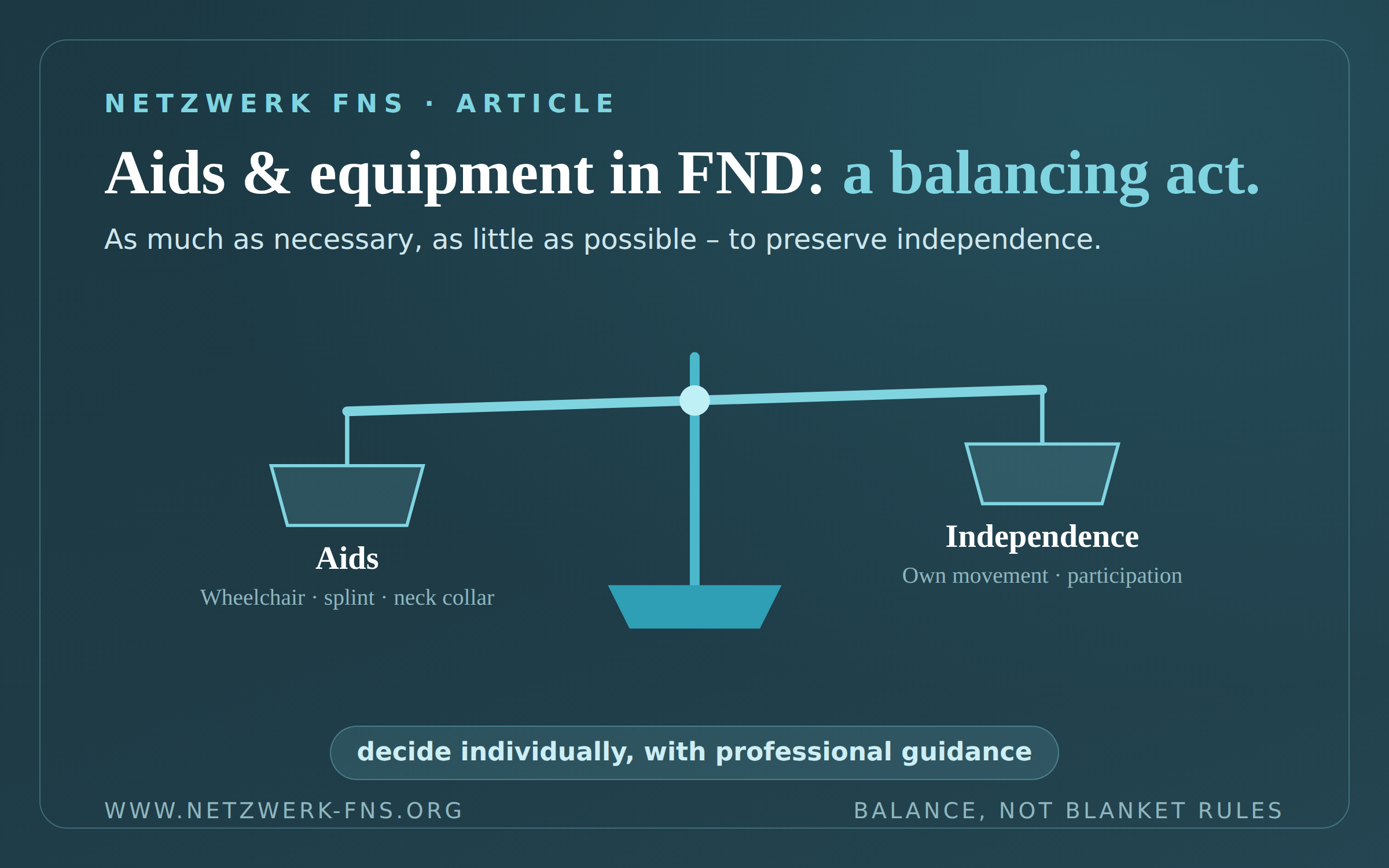
In Functional Neurological Disorders (FND), the underlying structures – nerves, muscles, brain – are intact, and yet something does not work as usual: walking, standing, gripping, speaking. The symptoms are real and not produced voluntarily. They do not arise from damage, but from an altered control and perception of movement. Exactly this makes the question of aids so delicate: an aid can relieve – but in FND it at the same time intervenes in precisely that movement control that is out of step.
Why aids work differently in FND
To understand why aids are a balancing act here, it helps to look at the disorder itself. In FND, no structure is destroyed; rather, in movement the brain falls back on practised patterns and expectations, and attention plays a large role. An aid is therefore not neutral: it can give safety – but it can also teach the body to move “differently” permanently.
FND-experienced occupational therapy names this openly. Aids could “adversely change the way that we move and thus prevent or delay improvement” and favour secondary problems such as “joint pain and muscle deconditioning”. In the original:
“Adaptive equipment can adversely change the way that we move and thus prevent or delay improvement … secondary problems such as joint pain and muscle deconditioning.”— neurosymptoms.org, patient guide by Prof. Jon Stone (occupational therapy in FND)
Conversely: whoever does everyday activities as normally as possible and with “less dependence on aids” thereby builds strength, endurance and self-confidence – because “participation acts to build functional strength, endurance and confidence” (neurosymptoms.org). That is the heart of the dilemma: what relieves in the short term can stand in the way in the long term – and what is exhausting can help in the long term.
A real balancing act
The special thing in FND: both directions can entrench the symptoms – too many aids just as much as none at all. Professionally, therefore, no rigid “yes” or “no” is recommended, but a careful weighing-up in the individual case.
Too many, too early
If aids are used early and permanently, the body can get used to avoidance movement patterns; the return to normal movement becomes harder. In addition, consequences such as muscle wasting, weakness, joint and pain complaints threaten – and with every additional aid a piece of lost independence.
Too few, none at all
Whoever is not mobile can be confined to the home, lose contacts and participation and physically decondition. Falls and injuries are also a real risk. This too can intensify symptoms and make the way back harder.
Why one day is not like another
A core feature of FND is fluctuation. The same legs that carry one to the shops in the morning can hours later feel “weak, heavy, stiff, unsteady or stuck” (FND Connect). Triggers are, for example, exhaustion, stress, sensory overload, pain, poor sleep or simply too much activity at a stretch.
This explains why someone needs an aid on one day and not the next – and why sentences like “But yesterday you could walk” hurt so much: they hit the fear of not being taken seriously. This variability is a feature of the condition, not a contradiction and not faking. In this light, aids are
“… practical tools that enable participation in life – not an admission of defeat.”— FND Connect, “But You Walked Yesterday”: on the part-time use of a wheelchair or walking stick
The guiding idea is: pace your strength instead of overspending it – “pacing, not racing”. An aid that enables participation on a bad day can therefore be entirely sensible – what matters is that it does not unnoticed become a permanent solution.
What the professional world recommends
The international physiotherapy consensus recommendation is clear and at the same time nuanced. It advises:
“Avoid use of adaptive equipment and mobility aids (though these are not always contra-indicated).”— Nielsen G, Stone J, Matthews A, et al., J Neurol Neurosurg Psychiatry 2015
Aids are therefore to be avoided where possible, but expressly not generally forbidden. If one is necessary for safety reasons (for example “to ensure safety after proven injuries”), it should be regarded as temporary and connected with a plan for gradual reduction – “it should be considered as temporary and provided with a plan to wean its use”. Whoever uses a wheelchair should – as safely as possible – keep opportunities to stand and move (“the opportunity to stand and mobilise as much as is safe and possible”). And in people whose limitation persists despite treatment, aids “may improve independence and quality of life” – then they are sensible and right (Nielsen et al. 2015).
The occupational therapy consensus recommendation adds what it is about at its core: “Education, rehabilitation within functional activity and the use of taught self-management strategies are central to occupational therapy intervention for FND” (Nicholson et al. 2020) – that is, education, practice in normal everyday life and self-learned strategies, not the provision of ever more aids. The German S2k guideline “Functional Movement Disorders” (DGN 2026) also relies on an actively oriented therapy. The practical advice of the professional world is, again and again: common sense and advice from therapists “who understand FND”.
Sometimes it can be therapeutically and medically sensible to consciously reduce or leave out an aid – even if that sounds hard at first. This is no punishment and no “don’t make such a fuss”, but part of a treatment plan meant to promote the return of movement. What is decisive is: individual, accompanied, never abrupt and never alone.
Why an outside view counts
Because both directions can harm and because FND fluctuates from day to day, the right balance can hardly be found alone. Decisions about aids therefore belong in consultation with doctors and – where possible – FND-experienced therapists, weighed up individually: what helps here and now? What keeps one healthy? What promotes the next step? Important is that the accompanying professional really knows FND, because the treatment differs from classic approaches. Many of those affected experience exactly this weighing-up as overwhelming – that is entirely understandable, and no one has to make it alone.
Finding FND-experienced points of contact
Especially with aids, accompaniment by FND-experienced therapists is worthwhile. Our overview brings together clinics, out-patient clinics and practices (physio/OT/speech).
To the clinic & practice list →Sources
The recommendations on aids rest on international professional consensus (experience and available evidence), not on large randomised trials. The English original quotations are deliberately kept.
- Nielsen G, Stone J, Matthews A, et al. Physiotherapy for functional motor disorders: a consensus recommendation. J Neurol Neurosurg Psychiatry. 2015;86(10):1113–1119. doi:10.1136/jnnp-2014-309255.
- Nicholson C, Edwards MJ, Carson AJ, et al. Occupational therapy consensus recommendations for functional neurological disorder. J Neurol Neurosurg Psychiatry. 2020;91(10):1037–1045. doi:10.1136/jnnp-2019-322281.
- Deutsche Gesellschaft für Neurologie. S2k guideline “Functional Movement Disorders”, 2026 (AWMF register 030/148).
- Prof. Jon Stone. Occupational Therapy, patient guide. neurosymptoms.org.
- FND Connect. “But You Walked Yesterday”: Using a Wheelchair or Walking Stick Part-Time With FND. fndconnect.org.uk.
This article serves general education and does not replace medical or therapeutic advice.