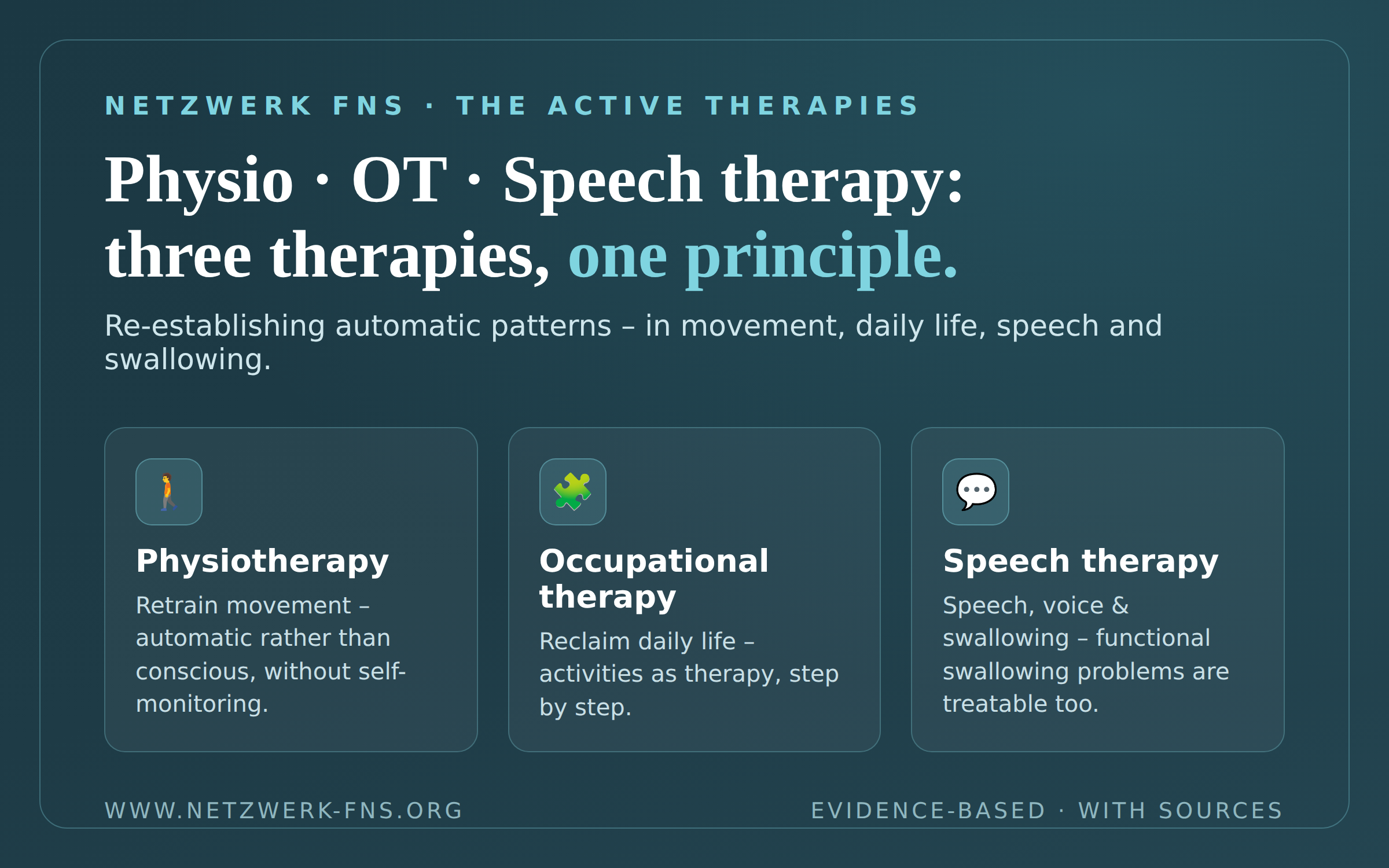
“But that’s just normal physiotherapy” – those affected and clinicians hear this sentence again and again, sometimes disappointed, sometimes dismissive. It rests on a misunderstanding. There is no protected additional qualification called “FND physiotherapy”, no “FND occupational therapy” and no “FND speech therapy”. What there is are internationally agreed treatment principles, thought of in the same way across all three professions – published as consensus recommendations in the journal Journal of Neurology, Neurosurgery & Psychiatry: for physiotherapy in 2015, for occupational therapy in 2020 and for speech and language therapy including swallowing disorders in 2021.1,4,5 What matters, therefore, is not the label on the practice door, but whether work follows these principles.
The essentials
- For physiotherapy, occupational therapy and speech and language therapy in FND there are international consensus recommendations – the therapy follows its own principles, not the classic rehab scheme.
- Shared core: re-establishing automatic patterns – movement, activity, speech and swallowing often succeed better in FND when attention is not directed at them.
- From the outside this can look like “quite normal” therapy – the difference lies in the how, not the what.
- FND-related swallowing disorders are treatable too; here, however, the evidence is still thin (expert consensus and case series rather than large trials).
- What achieves the most is a coordinated team in which everyone speaks the same language: FND is real, explainable and changeable.
One principle, three professions: using the automatic
FND means: the “hardware” of the nervous system is intact, but the interplay – the “software” – is disturbed. Typically, movements, speech or swallowing succeed worse precisely when one concentrates hard on them, and better when they happen in passing.1,5 This is exactly where all three therapies begin: they redirect attention, awaken automatic, over-learned sequences (for example via rhythm, walking, humming, everyday activities) and build normal function back up on this, step by step. This always includes an understandable explanation of the diagnosis – it is not an accessory, but itself a treatment factor.
“That looks like normal group physio”
True – sometimes it looks exactly like that. A circle of people, a ball, a walking course, an exercise on the bench. From the outside, therapy can look “normal” – what is decisive is what happens in the nervous system. In the FND-informed application, the exercise is not strength training, but a way of letting movement happen without self-monitoring. Whoever focuses on the ball in a game of catch forgets the leg – and suddenly it carries them. Experienced clinicians therefore emphasise: sometimes it is precisely in such seemingly “ordinary” situations that what helps becomes apparent – an important diagnostic and therapeutic moment, not evidence of arbitrariness.1
This also applies to mixed groups: even a physiotherapy group in which people with very different conditions train can be effective in FND – only there, partly different mechanisms take hold. Movement happens in meaningful, distracting activity, attention wanders away from the affected body part, and to this are added activation, rhythm and the social dynamic of the group – exactly the conditions under which automatic movement can return. The consensus recommendation accordingly states that rehabilitation can succeed even without an FND-specific setting, provided it is active and addresses perpetuating factors. To be honest: published studies specifically on group therapy in FND are still lacking; individual treatment is regarded as first choice, groups are described as sensible for selected patients under FND-experienced guidance.1 A blanket “group physio does nothing in FND” cannot, in any case, be derived from this – rather the opposite.
“I now need special FND physiotherapy” – an understandable but skewed expectation
Those who receive the diagnosis of FND often hear: “This needs specialised therapy.” From this easily arises the expectation that somewhere there must be a separate, certified “FND physiotherapy” or “FND occupational therapy” – and that everything else is worthless. This expectation is understandable, but not tenable scientifically in this form. First, such a protected specialisation simply does not exist; “FND-informed” describes a way of working, not a certificate. Second, the research itself provides the context: in the largest physiotherapy study of functional movement disorders to date (Physio4FMD, 355 participants), the specially developed special programme was, after twelve months, in its primary outcome not better than the comparison treatment – ordinary out-patient neuro-physiotherapy – and both groups improved.3 The right question is therefore not: “Is this a special FND therapy?”, but: “Is work here active, FND-informed and according to the consensus principles?” Well-done therapy works – regardless of whether “special programme” is written on it. And conversely: whoever waits for the “only correct” special therapy because of a nebulous ideal may lose months in which effective treatment would long have been possible.
Quantity is not quality – and “no FND physio” does not mean “no physio”
From patient reports we also know the reverse situation: a clinic says that no separate FND physiotherapy is integrated into its programme – the treatment plan is “already tight enough”, physiotherapy should take place on an out-patient basis after discharge if needed. For those affected, this quickly feels as if the condition is not being taken seriously. Two things help with the interpretation. First: a full weekly schedule is, in itself, not a quality feature – quantity is not quality. Research shows that precisely short, well-structured FND programmes can work: in a randomised study, even a five-day, FND-informed physiotherapy programme brought improvements considerably more often after six months than the standard referral, and the Physio4FMD protocol comprised a whole nine sessions.2,3 What is decisive are principles, fit and transfer into everyday life – not the number of applications. A lot of unspecific, above all passive therapy can even entrench patterns, because it directs attention and dependence onto the symptoms.1
Second: “We have no FND physio” does not mean that movement therapy does not help or is not needed in FND – only that this building block has to take place elsewhere. Out-patient physiotherapy can carry the FND approach; the large comparison study showed exactly that (see above).3 Legitimate, however, is the question of how the clinic integrates movement into its concept and whether the handover to out-patient follow-up happens in an FND-informed way – because multimodal means coordinated, not simply “a lot”. Whoever asks here in a friendly but concrete way (“According to which principles is movement treated with you? How is the out-patient physio connected?”) quickly learns whether a well-thought-out concept lies behind it.
Physiotherapy: re-establishing movement
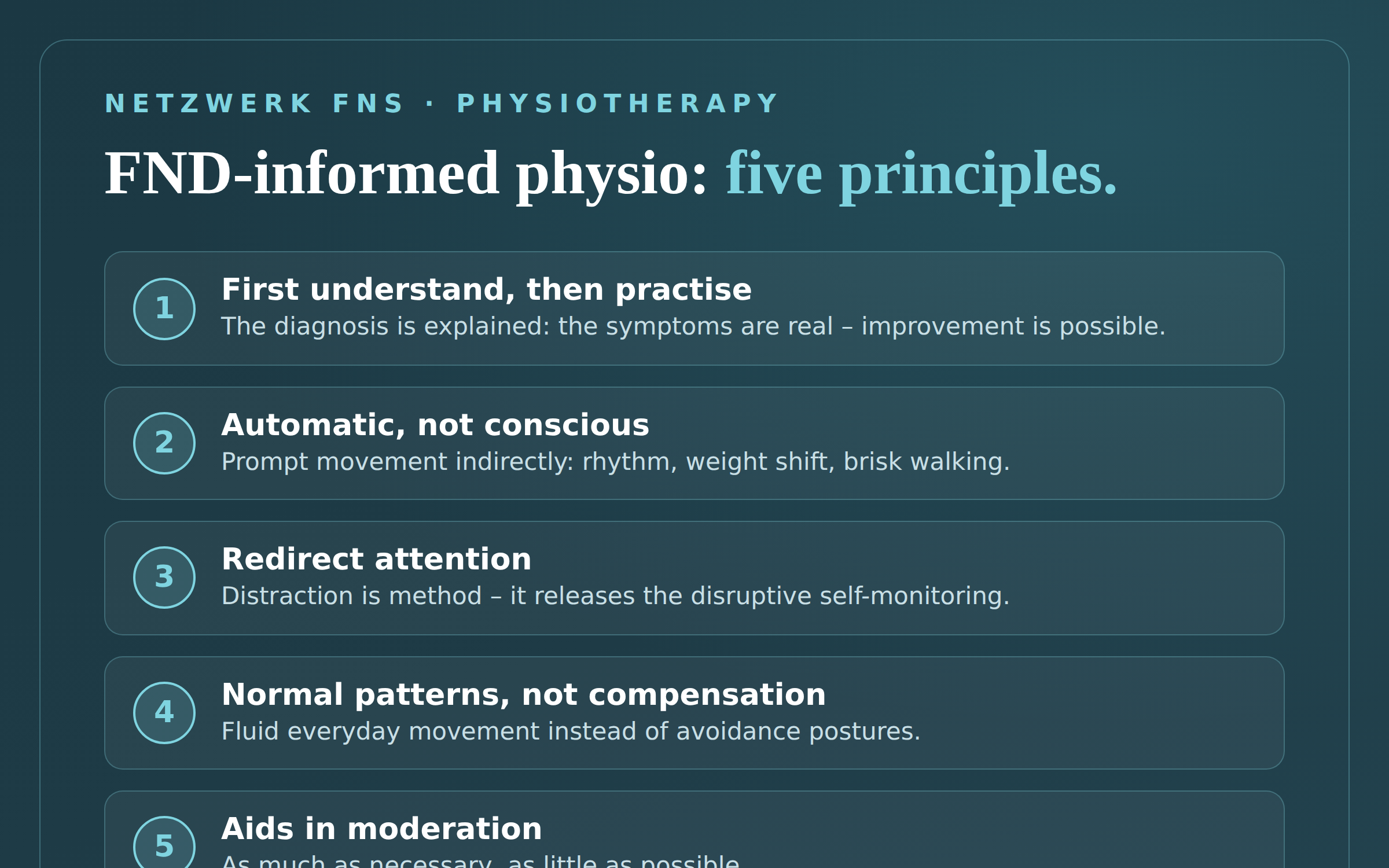
The consensus recommendations by Nielsen and colleagues describe how FND-informed physiotherapy differs from classic physical therapy:1
- First understand, then practise. The therapy begins with a shared explanation: why the symptoms are real and why improvement is possible.
- Automatic, not conscious. Movement is prompted via detours – weight shift, rhythm, brisk walking, stairs – instead of directly “training” the affected body part.
- Redirect attention. Distraction here is not a trick, but a method: it switches off the disruptive self-monitoring.
- Normal patterns instead of compensation. The aim is fluid everyday movements; avoidance postures and unnecessary supports would fix the disturbed pattern in place.
- Aids in moderation. As much as necessary, as little as possible.
A randomised feasibility study found improvements considerably more often after six months under FND-informed physiotherapy than under standard referral; the large follow-up study qualified the advantage over good neuro-physiotherapy (see above).2,3
Occupational therapy: reclaiming everyday life
While physiotherapy works on movement itself, occupational therapy works where FND hurts most: in everyday life. The consensus recommendations by Nicholson and colleagues describe, among other things:4
- Everyday activities as therapy. Cooking, dressing, shopping, commuting – familiar activities awaken automatic sequences and make progress immediately tangible.
- Graded activity. Demands are increased step by step – reliably planned rather than by daily form, to break the cycle of overload and rest.
- Self-management. Strategies for exhaustion, sensory overload and difficult days are expressly part of it.
- Participation in view. Workplace, school, home: occupational therapy also advises on adaptations – always with the aim of regaining function rather than permanently replacing it.
Speech and language therapy: speaking, voice – and swallowing
FND can also show itself in voice, speech and swallowing: sudden stammering, slurred speech, whispering voice or loss of voice, gagging and tightness. The consensus recommendations by Baker and colleagues transfer the same principles to speech and language therapy: explain what is happening; prompt automatic production – for example via humming, throat-clearing, yawning or singing, out of which voice and speech can be “coaxed”; generalise new patterns into everyday situations; plan for and discuss setbacks.5 Many of those affected experience surprisingly rapid progress here – a strong argument that the diagnosis is correct and improvement is possible.
FND-related swallowing disorder: take it seriously, treat it specifically
A functional swallowing disorder (functional dysphagia) can appear as a feeling of tightness in the throat (“globus”), as a fear of choking or as noticeably impaired swallowing. It predominantly affects the voluntarily controlled part of the swallowing act – and, as with all FND symptoms: the nervous system is intact, the sequence is disturbed, the symptoms are real.5,6 At the start stands a careful assessment (e.g. by an ENT specialist or with swallowing endoscopy) that achieves two things: providing reassurance – and naming positive features of the functional disorder, instead of only saying “nothing found”.
Treatment then follows the same principles as for the other symptoms: understanding that the swallowing reflex works and the disorder is reversible; specifically reducing the fear of swallowing; gradually resuming eating and drinking – from easy to more difficult consistencies, ideally embedded in distracting, everyday situations in which swallowing happens automatically; plus behavioural-therapy support where needed.5 Important for context: for functional dysphagia there are so far no randomised trials – the recommendations rest on expert consensus and case series. This does not mean that nothing helps; it means that treatment belongs in experienced hands and that nutrition and weight should remain medically monitored.5
How to recognise FND-informed therapy
- The diagnosis is explained to you – not just communicated.
- There is active practice, with distraction and everyday relevance – not passive massage or only stretching.
- Progress is measured by function (walking, handling, speaking, eating), not by strength values.
- Setbacks are planned for and discussed, instead of counting as failure.
- The disciplines talk to one another – and to you.
Read on
An overall overview of all treatment building blocks – including psychotherapy and specialised rehabilitation – is given by the article “Treatment of FND: what really helps”. FND-experienced clinics and practices can be found under “Clinics & practices”.
Sources
- Nielsen G, Stone J, Matthews A, et al. Physiotherapy for functional motor disorders: a consensus recommendation. J Neurol Neurosurg Psychiatry. 2015;86(10):1113–1119. doi:10.1136/jnnp-2014-309255. PMID 25433033.
- Nielsen G, Buszewicz M, Stevenson F, et al. Randomised feasibility study of physiotherapy for patients with functional motor symptoms. J Neurol Neurosurg Psychiatry. 2017;88(6):484–490. doi:10.1136/jnnp-2016-314408. PMID 27694498.
- Nielsen G, Stone J, Lee TC, et al. Specialist physiotherapy for functional motor disorder in England and Scotland (Physio4FMD): a pragmatic, multicentre, phase 3 randomised controlled trial. The Lancet Neurology. 2024;23(7):675–686. doi:10.1016/S1474-4422(24)00135-2. PMID 38768621.
- Nicholson C, Edwards MJ, Carson AJ, et al. Occupational therapy consensus recommendations for functional neurological disorder. J Neurol Neurosurg Psychiatry. 2020;91(10):1037–1045. doi:10.1136/jnnp-2019-322281. PMID 32732388.
- Baker J, Barnett C, Cavalli L, et al. Management of functional communication, swallowing, cough and related disorders: consensus recommendations for speech and language therapy. J Neurol Neurosurg Psychiatry. 2021;92(10):1112–1125. doi:10.1136/jnnp-2021-326767. PMID 34210802.
- Stone J, et al. Functional speech and swallowing symptoms – patient information. neurosymptoms.org (accessed 2026).
- Deutsche Gesellschaft für Neurologie (DGN). S2k guideline “Functional Movement Disorders”, AWMF register 030/148.
This article does not replace medical or therapeutic advice. Which therapy fits in an individual case – and how it is designed – is always decided together with FND-experienced professionals.