What is dissociation?
Normally the brain seamlessly joins everything that makes us who we are – perception, movement, thoughts, feelings and the sense of being “myself” – into a whole. In dissociation, parts of this temporarily decouple: the nervous system switches, as it were, into a different mode. This is not a sign of “being crazy”, but often a protective reaction – the system turns down the intensity when something becomes too much.
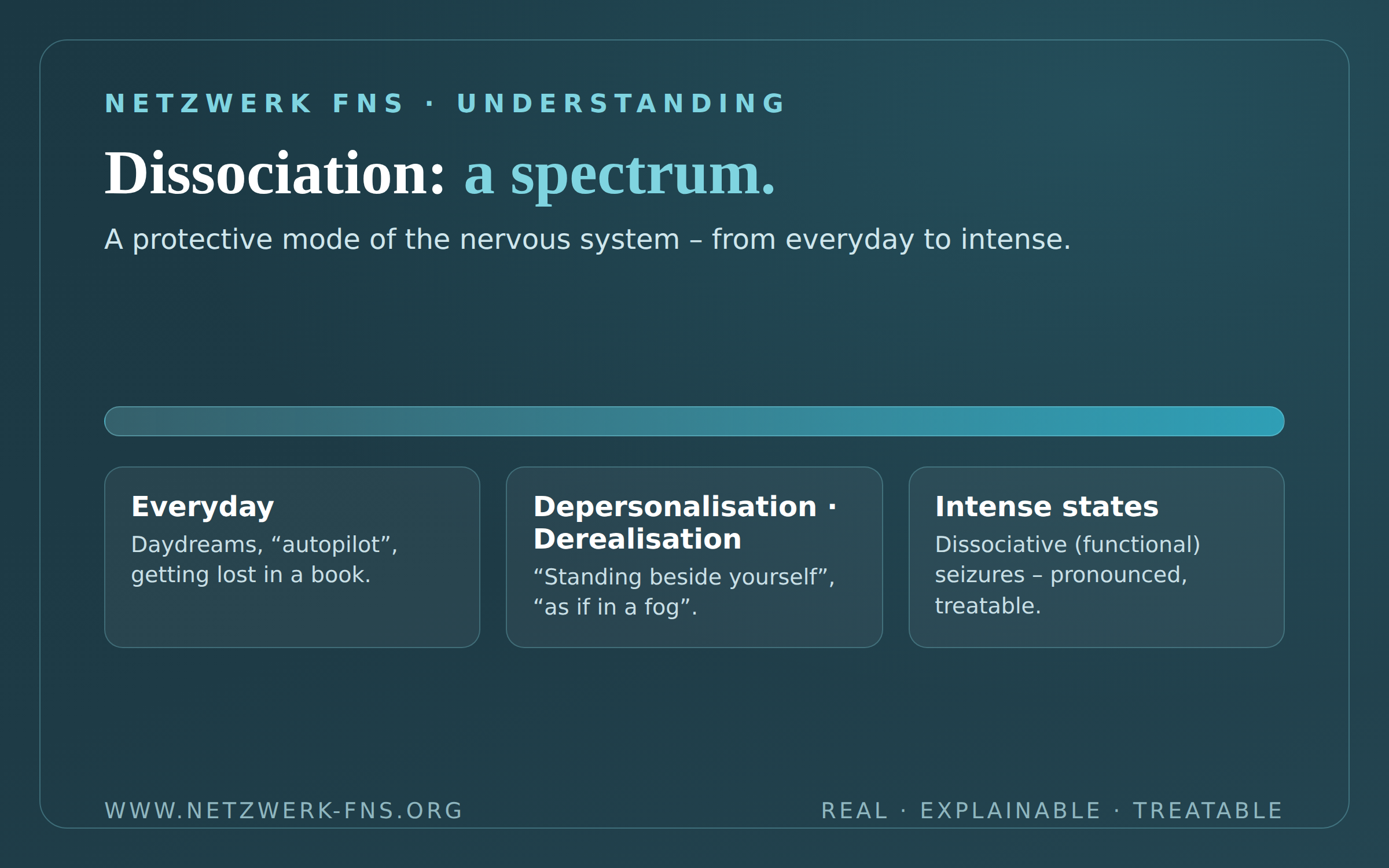
Dissociation is a spectrum. At the harmless end stands the everyday: daydreaming or the “motorway trance”, when you arrive and can barely remember the last few kilometres. Further along it reaches depersonalisation (feeling separated from one’s own body or self – “as if remote-controlled”, “as if behind glass”) and derealisation (the surroundings seem unreal – “as if in a fog”, “as if in cotton wool”, “as if in a film”). At the intense end stand pronounced dissociative states.
Important for context: mild, temporary experiences of depersonalisation or derealisation are very widespread – depending on the study, between a good quarter and three quarters of people experience them at least once in their lives. A pronounced, persistent depersonalisation/derealisation disorder, by contrast, affects about 1–2 %.3 In short: with this you are neither alone nor “wrong”.
What does it feel like?
The descriptions often resemble one another: as if behind a pane of glass, not quite in one’s own body, the environment as if in fog or cotton wool. Time can seem distorted, feelings dampened or “as if numbed”. Some experience themselves almost from the outside. This can be frightening – precisely because it feels so alien. Yet it is a state, not a character flaw, and in itself not dangerous.6
Dissociation and FND – the connection
Functional Neurological Disorders and dissociation are closely related. The current international classification ICD-11 lists functional neurological symptoms expressly as “dissociative neurological symptom disorder” (code 6B60).8 And indeed the research shows: in people with FND, dissociation is on average considerably more pronounced than in healthy people – a systematic review with meta-analysis found large effects for this.1
According to today’s understanding, this fits well together: in FND the control of movement and perception is out of step – it is not the “hardware” (nerves, muscles) that is damaged, but the “software”. A dissociative state is exactly such a moment in which the normal linking of perception, movement and self-control is briefly disturbed. In this way, dissociation can trigger or accompany functional symptoms.
Dissociative (functional) seizures
A particularly important example are dissociative seizures – also called functional seizures, formerly “psychogenic non-epileptic seizures”. Unlike epilepsy, there is no abnormal electrical discharge in the brain behind them, but a temporary, trance-like state of the nervous system.6
They can look very different: with vigorous movements (jerking, cramping) or without (motionlessness, “being zoned out”, often over minutes). Sometimes awareness is partly preserved, without one being able to control the seizure. Decisive – and often misunderstood: it happens automatically. It is not the case “that the person is doing this”;6 nobody acts it out or produces it on purpose.
Dissociative seizures can be recognised by typical features; most reliably with a video-EEG recording, with which experts correctly classify the seizure type in about nine out of ten cases.6 Important here too: the diagnosis is made through positive signs, not by mere exclusion.5 Common triggers are stress and sensory overload, but also rest without distraction, hyperventilation, pain – and depersonalisation.6 This is not “imagined epilepsy”, but an independent, real condition. See also our first-aid guide.
Does a trauma have to be behind it?
This question moves many – and the honest answer is: sometimes, but not always. Distressing experiences and traumas are on average more common in FND than in comparison groups. The largest review to date found, for example, emotional neglect in childhood in 49 % of those affected versus 20 % of controls, physical abuse in 30 % versus 12 %, and sexual abuse in 24 % versus 10 %; stressful life events before the onset of illness were also more common.2
But – and this is just as important: a substantial proportion of those affected report no such experiences. The same review expressly states that stressful events are not a core feature of the diagnosis.2 For you, this means something relieving in both directions: those who carry a trauma find in it a possible explanation – and those who find none do not have “less real” symptoms because of it. Nobody has to search frantically for a hidden trauma in order to be taken seriously and treated. The symptoms are real, quite independently of the history.
What helps
The good news: dissociation is influenceable and treatable. In the acute moment, many people are helped by grounding techniques that gently bring them back into the here and now – for example using the senses (naming what one sees, hears, feels), consciously feeling the feet on the floor, taking a clearly textured object in the hand, exhaling slowly and for longer, or orienting oneself aloud (“I am here, today is …”). Such exercises are not a miracle cure, but they put a tool in your hand.
In the longer term, an individually tailored psychotherapy is central – depending on the person, behavioural, depth-psychological or psychodynamic or, where appropriate, trauma-focused; ideally accompanied by professionals who really know FND.5 Specifically for dissociative seizures, cognitive behavioural therapy is best studied (CODES trial), embedded in an individual treatment plan.4 Treating accompanying complaints such as anxiety or depression, a calm daily routine, good sleep and pacing support the path. With understanding and targeted treatment, much can improve.
In an emergency
Dissociation can go together with anxiety or crises. If you are in an acute crisis or have thoughts of not wanting to live, you are not alone. In Germany, contact immediately:
- 112 – emergency call in life-threatening situations
- 116 123 – Telefonseelsorge (24 hours, free, anonymous)
- 116 117 – on-call medical service
If you are outside Germany, please contact your local emergency services or a crisis helpline.
Read on
Sources
- Campbell MC, Smakowski A, Rojas-Aguiluz M, et al. Dissociation and its biological and clinical associations in functional neurological disorder: systematic review and meta-analysis. BJPsych Open. 2023;9(1):e2. doi:10.1192/bjo.2022.597. PMID 36451595.
- Ludwig L, Pasman JA, Nicholson T, et al. Stressful life events and maltreatment in conversion (functional neurological) disorder: systematic review and meta-analysis of case-control studies. Lancet Psychiatry. 2018;5(4):307–320. doi:10.1016/S2215-0366(18)30051-8. PMID 29526521.
- Hunter ECM, Sierra M, David AS. The epidemiology of depersonalisation and derealisation: a systematic review. Social Psychiatry and Psychiatric Epidemiology. 2004;39(1):9–18. doi:10.1007/s00127-004-0701-4.
- Goldstein LH, Robinson EJ, Mellers JDC, et al. Cognitive behavioural therapy for adults with dissociative seizures (CODES): a pragmatic, multicentre, randomised controlled trial. Lancet Psychiatry. 2020;7(6):491–505. doi:10.1016/S2215-0366(20)30128-0. PMID 32445688.
- Deutsche Gesellschaft für Neurologie (DGN). S2k guideline “Functional Movement Disorders”, AWMF register 030/148, 2026.
- Stone J. Functional (Dissociative) Seizures. Patient information, neurosymptoms.org.
- Popkirov S. Funktionelle neurologische Störungen – Erkennen, verstehen, behandeln. Springer, 2020.
- World Health Organization (WHO). ICD-11 for Mortality and Morbidity Statistics: Dissociative neurological symptom disorder (6B60).
Further patient information: neurosymptoms.org (Prof. Jon Stone) and the Deutsche Hirnstiftung.
This article does not replace medical or psychotherapeutic advice. It summarises the current state of research in generally understandable terms; individual courses may differ.