The essentials
- In research, acceptance is not giving up, but an active process: to stop fighting against the now – in order to get the strength for life back.
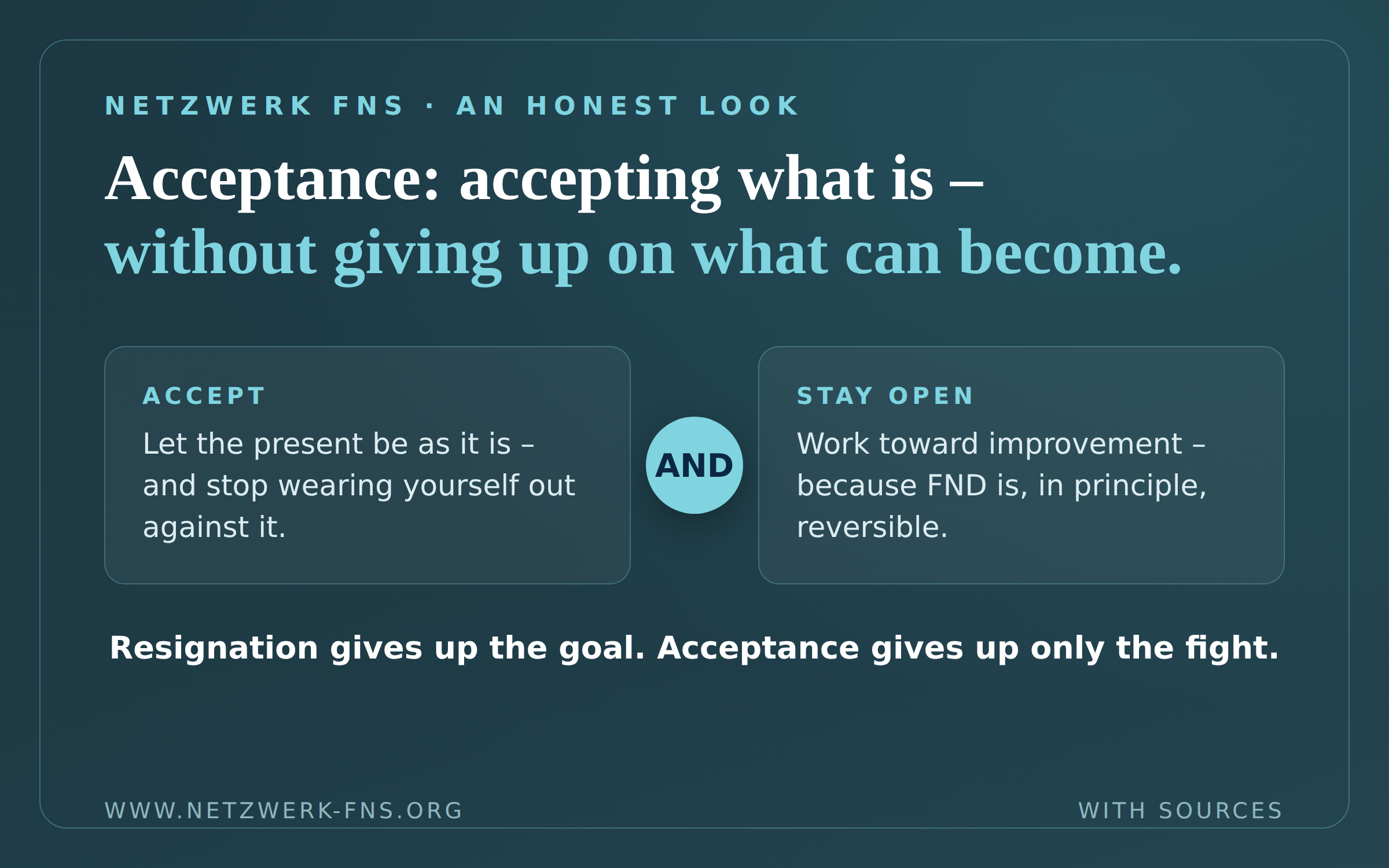
- Resignation gives up the goal. Acceptance gives up only the fight – it keeps the goal.
- In FND, a fine, important line applies: accepting the diagnosis demonstrably helps – declaring the symptoms unchangeable would be wrong, because FND is, in principle, reversible.
- Acceptance can also come too quickly – then it is sometimes a quiet farewell to hope. And it cannot be prescribed, neither by others nor by oneself.
What acceptance really means
In everyday language, “accepting” sounds like capitulation: resigning oneself, striking the sails, keeping quiet. Psychological research means almost the opposite. There, acceptance is an active, ongoing process: the willingness to let difficult sensations, thoughts and symptoms be there, without putting all one’s strength into fighting them – and instead putting that strength back into what matters to one.1,2 Experts describe two sides of this stance: the willingness to experience the unpleasant, and the willingness to act again nonetheless.2
Acceptance is therefore not a feeling that one at some point “has”, and certainly not indifference. It is more of a movement – new each day: It is just so right now. And I live nonetheless in the direction of what matters to me. Remarkable is what research shows about this: how well people with a chronic condition function and live often depends more on this stance than on the extent of the symptoms themselves.2,3
Acceptance is not resignation
The difference can be put in one sentence: Resignation gives up the goal. Acceptance gives up the fight – not the goal. Resignation says: “There is no point any more.” Acceptance says: “I stop wearing myself out against the unchangeable of today – so that tomorrow I have room to move again.” The one makes life narrow and quiet. The other makes it wide again.
Whoever has ever tried to push a symptom away with pure will knows the balance of this fight: it costs enormous strength, it occupies the thoughts, and often it makes everything worse. Research calls this permanent programme experiential avoidance – the constant wanting to push away, control and get rid of inner states – and counts it among the most reliable amplifiers of suffering.1,3 In FND, a special feature is added that those affected know only too well: many symptoms become stronger the more attention they receive. And what is the fight against a symptom other than attention in its most intense form? Acceptance releases exactly this grip. It takes out pressure and self-monitoring – and thereby creates the conditions under which walking, speaking or rest can succeed “in passing” again.
That this stance not only comforts but works is shown by the evidence on Acceptance and Commitment Therapy (ACT), which builds acceptance specifically: reviews and meta-analyses find, in chronic conditions – best studied in chronic pain – consistent improvements in functioning, mood and quality of life.3,4
The special case of FND: accept the starting point, not the result
In FND, acceptance has a double role – and exactly here it is decided whether it helps or harms. On the one hand, accepting the diagnosis is demonstrably a factor in its own right: those who understand and accept that it is FND and why the symptoms are real can end the wearing search for the “missing finding” – the guidelines expressly emphasise this diagnostic acceptance as part of the treatment.5,6 This acceptance is a door-opener: out of the odyssey, into the therapy.
On the other hand, FND is in principle reversible – it is not the structure of the nervous system that is damaged, but its interplay, and interplay can be re-trained.5,7 That is why it would be a momentous misunderstanding to apply “acceptance” to the symptoms themselves and declare them permanent. The helpful formula is: one accepts the starting point – not the end result. Accepting the now and at the same time working on improvement is no contradiction. It is the basic attitude of every effective FND therapy: going to the appointment in a wheelchair today and working towards needing it less often one day.
“I have totally accepted it” – when accepting becomes holding on
And now to the most uncomfortable facet, rarely spoken openly in communities: sometimes acceptance comes suspiciously quickly. “I have completely accepted it” can be the result of a long, honest journey – matured, hard-won, sustainable. But it can also, without the person themselves noticing, mean something else: I don’t actually want it to go away any more.
This is no reproach, and it does not happen on purpose. It has understandable reasons: a long illness grows into identity – it orders daily life, brings community, language and a role in which one is finally seen. Recovery can then, paradoxically, feel like a loss.8 An “acceptance” that in truth protects this structure is no peace with the illness – it is a quiet farewell to hope, disguised as maturity. The difference is barely visible from the outside, but testable from within, with a single question: Does my acceptance keep my life moving – or does it hold it still? Does it open doors to what matters to me – or does it silently lock the door marked “improvement”? (How such connections arise, quite without intent, is described in our article “When illness also gives something”.)
Acceptance cannot be prescribed
A last facet belongs here, especially for family and friends: acceptance is nothing one can demand of another person. “You just have to accept it” – said from outside, often well meant – rarely arrives at the other as wisdom, but as a short cut: Stop bothering me with your suffering. Genuine acceptance ripens from within, at its own pace, and it expressly includes grief: for plans, for things taken for granted, for the life one had imagined differently. This grief is no detour, but part of the path – accepting is always also saying goodbye.8
And it is no switch, but a pendulum: today it succeeds, tomorrow one struggles again, the day after both lie within an hour. That is no relapse and no failure – that is how the process looks for almost everyone.2 Whoever condemns themselves for “still not being that far” has only opened a second front in the old fight. Even dealing with one’s own impatience may – practise acceptance.
Four touchstones for an acceptance that carries
- Direction: Does it bring me closer to what matters to me – or further away from it?
- Room to move: Has my life become bigger with it – or smaller and quieter?
- Openness: Is improvement still allowed to happen – or would it now have something to lose?
- Tone: Do I speak to myself as to a person I like – or as to a case that should finally be closed?
If these questions stir something up: that is exactly what psychotherapy is for – especially acceptance-based approaches accompany this process effectively. You do not have to walk it alone.
Read on
Why illness can also give something and become identity is explored in “When illness also gives something”. Why the endless search for causes itself becomes a burden is shown by “The Spiral”. And what really influences the course is under “Prognosis in FND”.
Sources
- Hayes SC, Strosahl KD, Wilson KG. Acceptance and Commitment Therapy: The Process and Practice of Mindful Change. 2nd ed. New York: Guilford Press; 2012.
- Thompson M, McCracken LM. Acceptance and related processes in adjustment to chronic pain. Current Pain and Headache Reports. 2011;15(2):144–151. doi:10.1007/s11916-010-0170-2.
- McCracken LM, Vowles KE. Acceptance and Commitment Therapy and Mindfulness for Chronic Pain: Model, Process, and Progress. American Psychologist. 2014;69(2):178–187. doi:10.1037/a0035623.
- Lai L, et al. Acceptance and commitment therapy for patients with chronic pain: a systematic review and meta-analysis on psychological outcomes and quality of life. PLOS ONE. 2024;19(4):e0301226. doi:10.1371/journal.pone.0301226.
- Espay AJ, Aybek S, Carson A, et al. Current Concepts in Diagnosis and Treatment of Functional Neurological Disorders. JAMA Neurology. 2018;75(9):1132–1141. doi:10.1001/jamaneurol.2018.1264.
- Deutsche Gesellschaft für Neurologie (DGN). S2k guideline “Functional Movement Disorders”, AWMF register 030/148 – among others on empathetic diagnosis communication and diagnostic acceptance.
- Gelauff J, Stone J. The prognosis of functional (psychogenic) motor symptoms: a systematic review. J Neurol Neurosurg Psychiatry. 2014;85(2):220–226. doi:10.1136/jnnp-2013-305321.
- Charmaz K. Loss of self: a fundamental form of suffering in the chronically ill. Sociology of Health & Illness. 1983;5(2):168–195. doi:10.1111/1467-9566.ep10491512.
This article serves general education and does not replace medical or psychotherapeutic advice. If this topic stirs something up in you, that is no flaw – but a good reason to think it through further with an FND-experienced therapist.