In advance – so that no misunderstanding arises
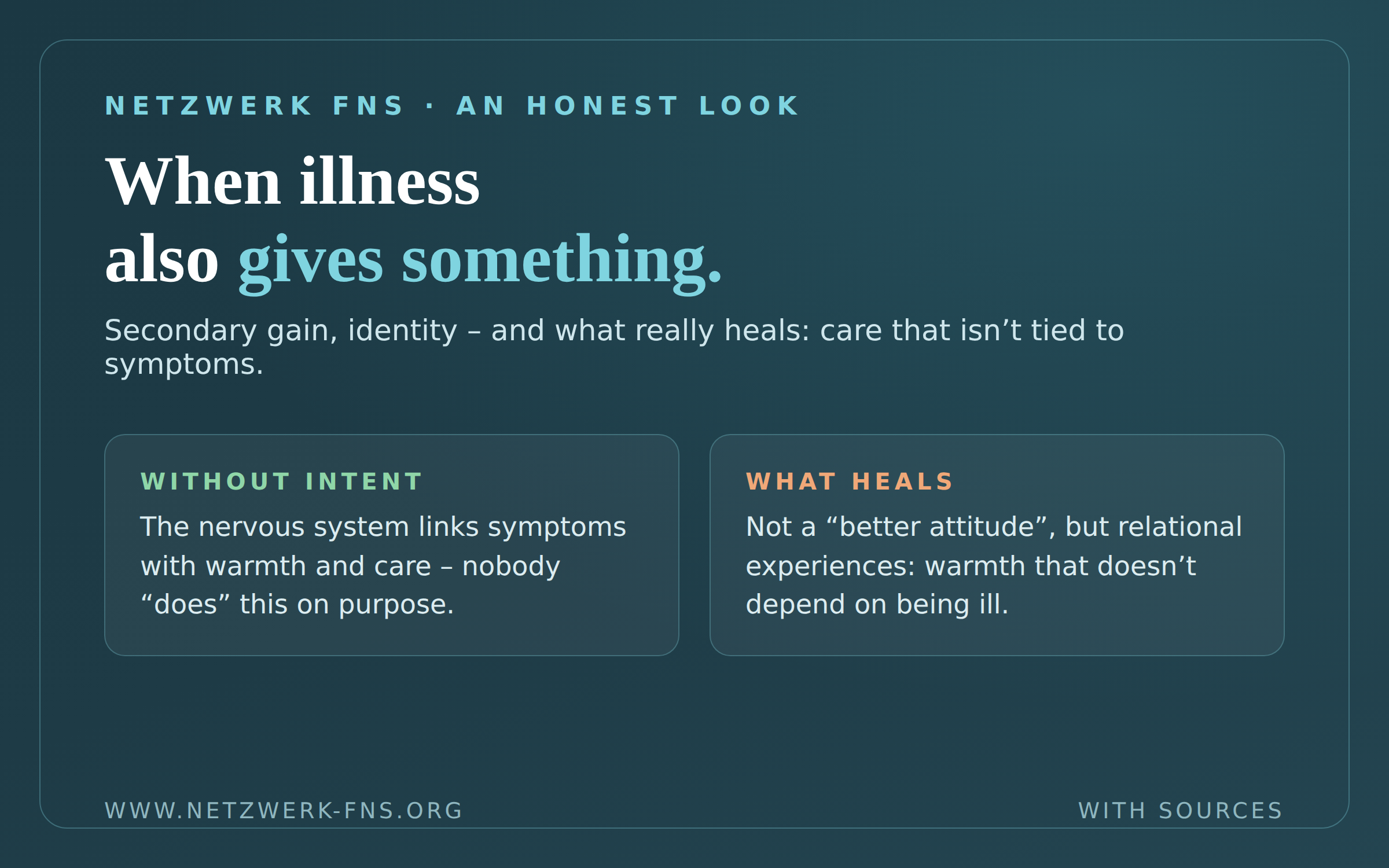
- Secondary gain is no reproach and has nothing to do with faking or “exploiting”. FND symptoms are real and not produced voluntarily.
- It is about learning processes below the will – the nervous system links things without asking us.
- The needs behind it – warmth, security, appreciation – are deeply human and legitimate.
- What heals is not a “better attitude”, but new relational experiences: care that is not tied to symptoms.
What “secondary gain” means – and what it does not
The term comes from psychoanalysis: Sigmund Freud described that an illness, besides its suffering, can also have consequences that carry something relieving – consideration, being cared for, release from being overwhelmed.1 Sociology later described the “sick role”: whoever is ill may hand over duties and has a claim to care – this is socially agreed and initially entirely right.3
Important is what the term does not mean. It does not mean that someone uses their illness to get something. Research is clear here: the term was often misused in practice to impute intent to patients – there is no scientific basis for that.2 For FND this applies doubly: the diagnostic criteria expressly do not require proof that symptoms are unintentional – because experts know that FND symptoms are not produced voluntarily; deliberate feigning is a completely different, rare category.4,11 So when we speak here about secondary gain, we are not speaking about blame. We are speaking about learning.
This also includes: even the word itself is unfortunately chosen. “Gain” sounds of advantage, calculation and intent – and thereby suggests exactly the misunderstanding the term does not actually mean. In fact it describes unintended reliefs that no one chose and that in no way outweigh the losses through the illness – health, participation, plans, strength. No one “gains” through FND. This is also why experts argue for using the term carefully or speaking more neutrally of perpetuating factors.2,6
How the nervous system learns without asking us
Our brain constantly links experiences – not because we want it to, but because it is built that way. When something good reliably follows a symptom – someone comes, someone cares, for the first time in a long while there is warmth – then the nervous system registers this link. It is not the self that decides this; it happens at the same level at which we also learn walking, habits and fears. Modern FND research describes symptoms as the result of expectation and attention processes in the brain – predictions that take on a life of their own.5 Into this system flows everything that makes symptoms meaningful – including the good that follows them. In this way, quite without intent, a cycle can arise: the symptom delivers what is painfully missing in life – and thereby becomes more stable. The treatment recommendations expressly count such perpetuating factors among the things that belong in a good therapy – without attribution of blame, but also without taboo.6
When illness becomes identity
There is a second, deeper level. A longer illness changes who we are: appointments, language, everyday life, contacts – much organises itself around the illness. Research calls it engulfment when the illness fills the self-image so far that little room remains beside it – a pattern that demonstrably goes together with worse well-being.7,8 Added to this is something very human: in illness, many find for the first time a community that understands them, a language for their suffering, a role in which they are seen. This is a real value – and no one gives up their identity voluntarily. Recovery can then, paradoxically, feel like a loss: who am I if I am no longer the sick one? Who will still care about me then?9
From reports of those affected, an unsettling moment is known: a clinician says it would be nice if much got better again – and instead of joy, a queasy feeling stirs. Because the good that came with the illness – warmth, security, appreciation, being cared for – understandably no one wants to give back. Such a moment is no evidence that someone “does not want to get well”. It is a sign of honest looking – and it shows exactly the point at which healing must begin.
Why “change your attitude” is the wrong answer
Whoever has read this far might draw the conclusion: then one simply has to let go, readjust, think positively. That is exactly the short circuit we would like to warn against. Because the cycle does not exist because someone thinks wrongly – it exists because a real need was, over a long time, not met otherwise. The wound is a relational wound. And relational wounds do not heal through tablets and not through willpower, but through new, corrective relational experiences: the experience of receiving warmth and appreciation without symptoms being the price for it. Psychotherapy research confirms this impressively – the sustaining therapeutic relationship is among the strongest known factors of all, across all schools of therapy.10
Practically this means: there is a need for places where one appears as a whole person – not only as a patient. A therapy in which needs may also be spoken about, not only symptoms. Relationships in which care does not depend on how one is feeling. And for family and friends it means, perhaps the most important thing: Be there when things are going well – not only when things are going badly. Whoever shows closeness only with symptoms unintentionally reinforces the link; whoever accompanies outings, progress and good days just as much decouples it. A community, too, can be both: a place that only shares suffering – or one that celebrates recovery too. We want to be the second.
Questions for honest looking – without blame
- What has the illness brought into my life that was missing before?
- Who would I be – and who would stay with me – if I were better?
- Do I receive warmth, closeness and appreciation also independently of symptoms?
- What would have to be there in my life so that getting well would not be a loss?
- With whom can I speak about exactly these questions – without being judged?
These questions do not replace psychotherapy – but they are a good start for one. It is a sign of strength to ask them of oneself.
Read on
Why body and mind belong together in FND is explained by “Body and mind”. How an endless search for causes can itself become a burden is shown by “The Spiral”. And which therapies concretely help is under “Physio, OT & speech therapy” and “Treatment of FND”.
Sources
- Freud S. Introductory Lectures on Psychoanalysis (1916/17), 24th lecture – concept of primary and secondary gain from illness; cf. also “Fragment of an Analysis of a Case of Hysteria” (1905).
- Fishbain DA, Rosomoff HL, Cutler RB, Rosomoff RS. Secondary Gain Concept: A Review of the Scientific Evidence. The Clinical Journal of Pain. 1995;11(1):6–21. PMID 7787338.
- Parsons T. The Social System. Glencoe: Free Press; 1951 (concept of the “sick role”).
- Stone J, LaFrance WC Jr, Brown R, et al. Conversion disorder: current problems and potential solutions for DSM-5. Journal of Psychosomatic Research. 2011;71(6):369–376. doi:10.1016/j.jpsychores.2011.07.005 – on the removal of the “not feigned” criterion; implemented in: American Psychiatric Association. DSM-5. 2013.
- Edwards MJ, Adams RA, Brown H, Pareés I, Friston KJ. A Bayesian account of “hysteria”. Brain. 2012;135(11):3495–3512. doi:10.1093/brain/aws129.
- Nielsen G, Stone J, Matthews A, et al. Physiotherapy for functional motor disorders: a consensus recommendation. J Neurol Neurosurg Psychiatry. 2015;86(10):1113–1119 (perpetuating factors).
- Oris L, Rassart J, Prikken S, et al. Illness Identity in Adolescents and Emerging Adults With Type 1 Diabetes. Journal of Pediatric Psychology. 2016;41(7):715–729. PMID 26989179.
- Van Bulck L, Luyckx K, Goossens E, Oris L, Moons P. Illness identity: Capturing the influence of illness on the person’s sense of self. European Journal of Cardiovascular Nursing. 2019;18(1):4–6.
- Charmaz K. Loss of self: a fundamental form of suffering in the chronically ill. Sociology of Health & Illness. 1983;5(2):168–195.
- Flückiger C, Del Re AC, Wampold BE, Horvath AO. The alliance in adult psychotherapy: A meta-analytic synthesis. Psychotherapy. 2018;55(4):316–340.
- Bass C, Halligan P. Factitious disorders and malingering: challenges for clinical assessment and management. The Lancet. 2014;383(9926):1422–1432 (distinction: deliberate feigning is something fundamentally different from FND).
This article does not replace psychotherapy or medical advice. If these questions occupy you, that is no flaw, but a good reason to think them through further with an FND-experienced therapist.