For a long time, Functional Neurological Disorder was regarded as what remains when “nothing is found”. This picture is outdated. Today FND is diagnosed positively – on typical clinical signs – and understood as a disorder of the function of the nervous system that arises from an interplay of several factors. This article sets out both: how it is diagnosed and what is considered a cause.
The essentials
- FND is no longer a diagnosis of exclusion – it is recognised by typical positive signs.
- Imaging such as MRI is usually normal – this fits the diagnosis and does not contradict it.
- There is not one single cause: usually several factors work together.
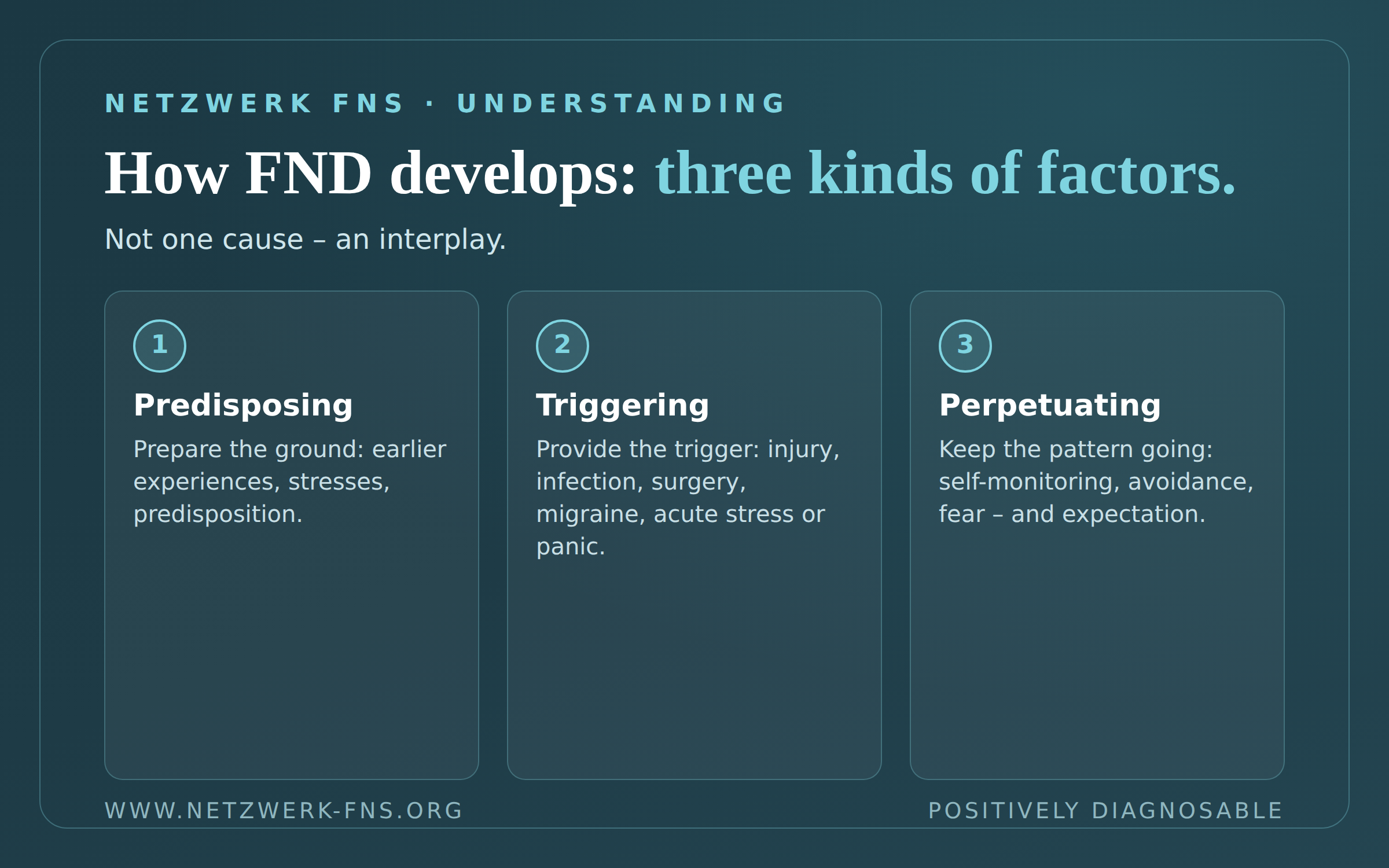
- Helpful is the biopsychosocial model: predisposing, triggering and perpetuating factors.
- A trauma can play a role, but is not a precondition for the diagnosis.
- What is disturbed is the interplay within the nervous system – not its structure.
How is FND diagnosed?
The most important change of recent years: FND is no longer established by ruling out all other conditions. It is made positively – that is, on examination findings that are typical of a functional disorder and distinguish it from other conditions.1,2 The current guidelines and diagnostic systems provide for this as well.5 A carefully made FND diagnosis is reliable: that a different condition later turns out to be behind it is the absolute exception.1
What are “positive signs”?
Positive signs are small, well-studied tests in the neurological examination that show that a function is in principle present but not available on demand – typical of FND. Well known is, for example, Hoover’s sign: a functionally weakened leg extension returns as soon as the other leg is flexed against resistance – the movement therefore succeeds automatically, only not on direct command. Similar signs exist for functional tremor (it “jumps” onto a given rhythm) or for gait and visual disturbances.3 These signs are not a trick and not a “catching out”: they demonstrate that the symptoms are real and originate in disturbed control.
What role do MRI, EEG & co. play?
Instrument-based investigations such as MRI, CT or EEG are usually normal in FND. This is not a contradiction to the diagnosis, but fits it: because there is no structural damage in FND, nothing “broken” can be seen on the image. Imaging is used mainly to exclude other causes in unclear cases – but the FND diagnosis itself rests on the clinical signs, not on the absence of a finding.1,2 That is why an endless search for the “overlooked finding” rarely helps. Why this search can itself become a burden is shown by the article “The Spiral”.
What causes FND?
The honest answer: not one single cause. FND generally arises from the interaction of several factors – physical, psychological and external. The common denominator is that the interplay within the nervous system is disturbed: the “hardware” is intact, but the control of movement, perception or attention is out of step.1,4 This is exactly why the symptoms are real – and at the same time, in principle, reversible.
The biopsychosocial model: three kinds of factors
To order this interplay, a simple way of thinking has proven useful – it distinguishes three roles that factors can play:4
Predisposing – factors that prepare the ground and increase vulnerability: for example earlier illnesses, physical complaints, ongoing strain or distressing life experiences.
Triggering – a concrete impetus that sets the symptoms in motion: often a physical event such as an injury, an infection, an operation, a migraine attack or a panic or acute stress reaction.
Perpetuating – factors that hold the pattern in place: for example constant self-monitoring of the symptoms, fear of movement, protective postures, or the worry that something might have been overlooked after all. Yet here also lies the opportunity – because these factors can be influenced.
What role does trauma play?
A trauma can be among the predisposing factors – distressing life experiences are on average more common in people with FND than in comparison groups. But it is not a precondition: a large proportion of those affected report no such history, and FND is therefore not a “hidden psychological illness”, but an independent disorder of nervous-system function.6 This question – with the exact figures – is explored in depth in the article “Dissociation”; it also covers dissociative (functional) seizures.
What happens in the nervous system
Put simply: in FND, the way the brain controls and predicts movements and perceptions gets out of balance. A major role is played by attention and expectation: if a movement is monitored too consciously or a particular disturbance is firmly “expected”, this can block the normal, automatic control. This explains why symptoms often ease when attention is distracted, and why they increase under tension.4 These mechanisms are at the same time the starting point of treatment.
Read on
How FND can be treated is covered in the article “Treatment of FND”. How it develops over time is shown by “Prognosis in FND”. And why an endless search for causes can itself become a burden is explained by “The Spiral”.
A vivid case report from the University Hospital Bonn ↗ describes, using the example of a 13-year-old, how long the path to diagnosis can be – and why early, integrative diagnostics rather than endless exclusion is so important (PDF, in German).
Sources
- Espay AJ, Aybek S, Carson A, et al. Current Concepts in Diagnosis and Treatment of Functional Neurological Disorders. JAMA Neurology. 2018;75(9):1132–1141. doi:10.1001/jamaneurol.2018.1264. PMID 29868890.
- Aybek S, Perez DL. Diagnosis and management of functional neurological disorder. BMJ. 2022;376:o64. doi:10.1136/bmj.o64. PMID 35074803.
- Daum C, Hubschmid M, Aybek S. The value of ‘positive’ clinical signs for weakness, sensory and gait disorders in conversion disorder: a systematic and narrative review. J Neurol Neurosurg Psychiatry. 2014;85(2):180–190. doi:10.1136/jnnp-2012-304607. PMID 23572514.
- Hallett M, Aybek S, Dworetzky BA, et al. Functional neurological disorder: new subtypes and shared mechanisms. The Lancet Neurology. 2022;21(6):537–550. doi:10.1016/S1474-4422(21)00422-1. PMID 35430029.
- Deutsche Gesellschaft für Neurologie (DGN). S2k guideline “Functional Movement Disorders”, AWMF register 030/148, 2026.
- Ludwig L, Pasman JA, Nicholson T, et al. Stressful life events and maltreatment in conversion (functional neurological) disorder: systematic review and meta-analysis of case-control studies. The Lancet Psychiatry. 2018;5(4):307–320. doi:10.1016/S2215-0366(18)30051-8. PMID 29526521.
This article does not replace medical advice. Diagnosing FND belongs in the hands of experienced clinicians who can reliably interpret the typical clinical signs.