What ableism is
The term comes from the US disability rights movement and Disability Studies and derives from “ability”. The ableism researcher Fiona Kumari Campbell describes it as a web of beliefs and practices that sets a particular standard of body and ability as “normal” and fully human – and thereby makes disability appear as a diminished state of being human.1 Ableism therefore means: people are measured by their abilities and defined by their impairment – sometimes openly hostile, sometimes subtle, sometimes well meant. In German the term overlaps with “hostility towards disabled people”, but is broader: it includes structures, everyday remarks (“microaggressions”), media clichés and internalised devaluation.2 The UN Convention on the Rights of Persons with Disabilities provides the normative framework: disability arises from the interaction between impairment and societal barriers – not from a person’s “defect”.3
Social psychology distinguishes two faces here: hostile ableism (devaluation, exclusion, denial of credibility) and benevolent ableism – over-protective treatment, unasked-for “helping”, decisions made over people’s heads, pity instead of eye level.4 Both take away people’s self-determination – the one through contempt, the other through paternalism.
Why the term is especially important for people with FND
People with Functional Neurological Disorders demonstrably experience above-average stigmatisation – including in healthcare itself. The research documents this broadly: derogatory labels, doubts about the reality of the symptoms, noticeably less engagement as soon as the diagnosis is made.5,6 Philosophy calls this epistemic injustice: those affected are systematically believed less as witnesses of their own experience.7,8 Whoever has ever heard the sentence “there is nothing wrong with you”, although the leg would not carry them, knows how that feels. For exactly these experiences, a name is needed – and for that, “ableism” is the right word. The term is not a battle cry, but an analytical tool: it makes visible patterns that would otherwise be dismissed as isolated cases.
Where the term tips over: when expertise becomes an accusation
As important as the term is – it can also be overstretched. The psychologist Nick Haslam coined the expression concept creep for this: concepts that describe harm and injustice widen over time and capture ever milder and ever more phenomena. This is partly progress – sensitivity grows – but carries a risk: if everything is ableism, at some point it is nothing any more; the term loses the power to hit real discrimination.9
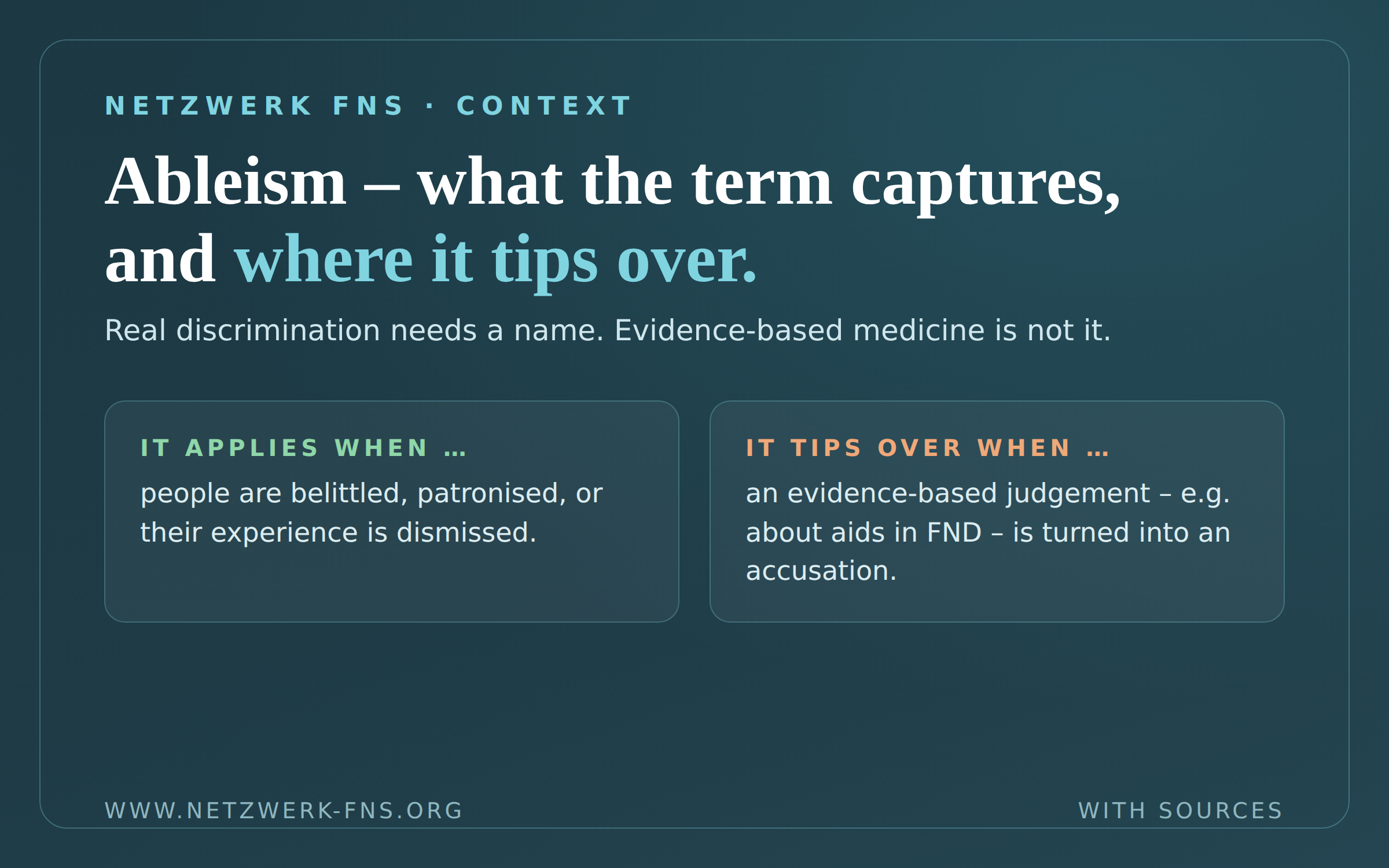
What does this overstretching look like concretely? It becomes clearest with a question over which the debate repeatedly ignites – posed in principle, independently of individual discussions: Is it ableism to tell a person with FND that an aid can entrench their symptoms – and that things can get better without it?
The answer of the specialist literature is unambiguous: No – this statement is not discrimination, but the state of the science. The international consensus recommendations for occupational and physiotherapy in FND expressly advise an individual weighing-up of aids: they can enable safety, independence and participation – and they can, in FND, entrench disturbed movement patterns, lead to joint problems and deconditioning, and delay improvement if used uncritically and permanently.10,11,12 The reason is no value judgement, but the mechanism of the condition: in FND the nervous system is structurally intact, function can return – a provision that fixes the disturbed pattern in place can stand exactly in the way of this return. This fundamentally distinguishes the situation from a structural damage, where a wheelchair simply establishes mobility and no one questions it. The comparison “no one would talk a person with paraplegia out of the wheelchair” therefore leads astray – it transfers the logic of an irreversible damage to a condition whose hallmark is fundamental reversibility.10,12
At the same time – and this is the balancing act one has to bear – it depends on the how. “We weigh up together whether the aid is helping you right now or slowing your improvement” is evidence-based, respectful medicine. The same message tips into paternalism when it comes across as blanket, over the head of the person affected or as an attribution of blame (“you’re sitting in there voluntarily”) – or when aids are refused where, after weighing up, they are necessary, for example in case of injury risk or persistent severe symptoms.11,12 As much as necessary, as little as possible is therefore no devaluation of aid users, but lived respect for their claim to maximum recovery. What this weighing-up looks like in practice is shown by our articles “Aids in FND – a balancing act” and “Physio, OT & speech therapy in FND”.
Generalised, the decisive difference lies between two kinds of statements: statements about people and statements about measures. “Anyone who uses a wheelchair is not really ill” – that is ableist: it devalues a person and denies them credibility. “In FND a wheelchair should be individually weighed up, because it can influence the course unfavourably” – that is an evidence-based statement about a measure, with the aim of more participation, not less. If the second statement is labelled as ableism, the term is taken to absurdity and turns against those it is meant to protect: those affected are then withheld what research knows about their treatment chances – and their real chance of improvement is sacrificed to the protection of a term. That, too, can be called paternalistic.9
Five test questions before saying “ableism”
- Is the statement directed against people (worth, credibility, belonging) – or does it evaluate a measure?
- Does it rest on evidence and can it be justified with sources – or on clichés?
- Does it allow individual weighing-up – or does it generalise in a blanket way?
- Does it aim at more participation and autonomy – or at exclusion and control?
- Are those affected denied competence over their own experience – or is something trusted to them?
And yet: the term remains necessary
This contextualisation is no licence to fend off every criticism of the ableism accusation. Benevolent ableism also exists in medicine: decisions over people’s heads, unasked-for touching and “helping”, the denial of quality of life, the assumption that one knows better than those affected what is good for them.4 And people with FND really experience not being believed.5,6 Both can be true at the same time: there is ableism in healthcare – and there are evidence-based treatment principles that are none. A term that can distinguish the two is stronger than one that hits everything. That is exactly why it is worth using it precisely.
Read on
Why balance counts with aids is explored in “Aids in FND – a balancing act”. How FND-informed therapy works is shown by “Physio, OT & speech therapy”. And why “psychological” does not mean “imagined” is explained by “Body and mind”.
Sources
- Campbell FK. Contours of Ableism: The Production of Disability and Abledness. London: Palgrave Macmillan; 2009.
- Maskos R. Ableismus und Behindertenfeindlichkeit. Bundeszentrale für politische Bildung (bpb.de), 2023.
- United Nations. Convention on the Rights of Persons with Disabilities. 2006 – esp. preamble (e) and Art. 1.
- Nario-Redmond MR. Ableism: The Causes and Consequences of Disability Prejudice. Hoboken: Wiley-Blackwell; 2020 (among others on hostile and benevolent ableism).
- MacDuffie KE, Grubbs L, Best T, et al. Stigma and functional neurological disorder: a research agenda targeting the clinical encounter. CNS Spectrums. 2021;26(6):587–592. PMID 33267932.
- A meta-ethnographic synthesis of the experiences of stigma amongst people with functional neurological disorder. Disability and Rehabilitation. 2023;45(10):1–12. doi:10.1080/09638288.2022.2155714.
- Fricker M. Epistemic Injustice: Power and the Ethics of Knowing. Oxford University Press; 2007.
- Byrne EA. Striking the balance with epistemic injustice in healthcare. Medicine, Health Care and Philosophy. 2020;23:371–379.
- Haslam N. Concept Creep: Psychology’s Expanding Concepts of Harm and Pathology. Psychological Inquiry. 2016;27(1):1–17.
- Nicholson C, Edwards MJ, Carson AJ, et al. Occupational therapy consensus recommendations for functional neurological disorder. J Neurol Neurosurg Psychiatry. 2020;91(10):1037–1045. PMID 32732388.
- Nielsen G, Stone J, Matthews A, et al. Physiotherapy for functional motor disorders: a consensus recommendation. J Neurol Neurosurg Psychiatry. 2015;86(10):1113–1119. PMID 25433033.
- Stone J, et al. Occupational therapy in FND – patient information. neurosymptoms.org (accessed 2026).
This article is a societal and scientific contextualisation, not legal advice and no substitute for individual medical advice. Whether and which aids fit in an individual case belongs in the joint weighing-up with FND-experienced professionals.