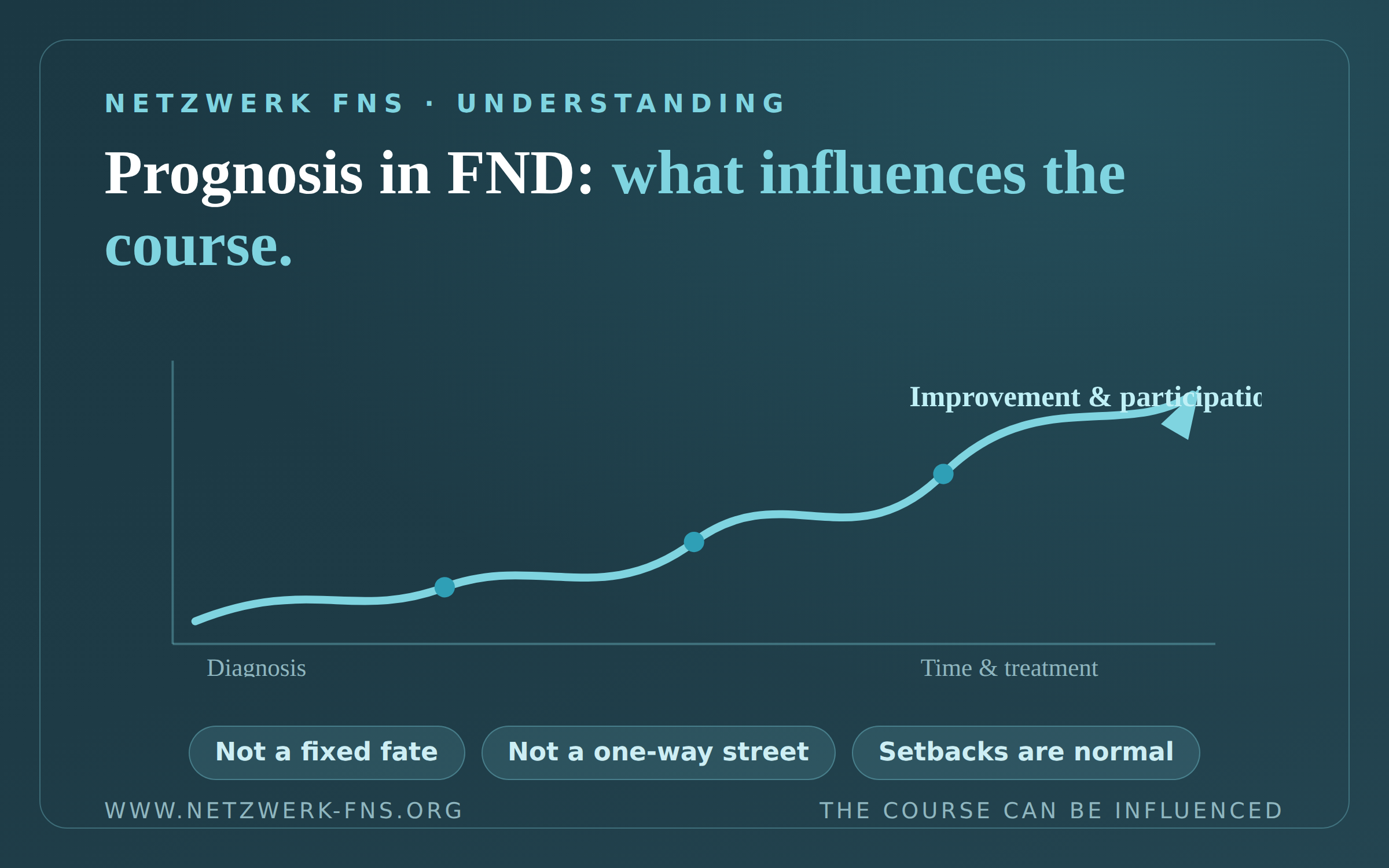
Hardly any question moves people as much after an FND diagnosis as this one: “Will it get better?” Answered honestly, that means: looking soberly at what the research shows – without pretending that everything is already decided. Because the prognosis in Functional Neurological Disorders is neither a fixed fate nor a one-way street.
The essentials
- FND is, in principle, reversible – a disorder of function, not of structure.
- The symptoms often do not improve on their own; waiting is rarely the best choice.
- With targeted treatment many improve – some become symptom-free, others remain restricted.
- Even long-standing symptoms can still improve: a long duration is not a final verdict.
- Understanding and accepting the diagnosis is part of the treatment.
- Children and adolescents have the most favourable outlook.
Is FND curable?
In short: there is no guarantee – but FND is, in principle, reversible, and many people experience a marked improvement, some become entirely symptom-free. That is the decisive difference from structural damage: in a Functional Neurological Disorder, the “hardware” of the nervous system is intact; what is disturbed is the interplay – and interplay can be re-trained.4 Whether one speaks of “curable” therefore depends less on a yes or no than on realistic expectations: in some the symptoms recede completely, in others they persist in a weakened form but become easier to manage. Two things make the greatest difference here – an early and well-explained, positively made diagnosis, and suitable treatment specialised in FND.4,5 Important is the message that even long-standing symptoms can still ease: a long duration of illness does not mean it is “too late”.7 Which treatment routes exist in FND is covered in the article “Treatment of FND”.
What the studies show
FND encompasses very different presentations – from weakness and paralysis through movement disorders to functional seizures – that do not run the same course. Across the studies, however, a common pattern emerges: without targeted treatment, the symptoms rarely disappear on their own. A 14-year study of functional weakness found, after this long period, around 20 % completely recovered, about 31 % improved and roughly half unchanged or worse.2 Older reviews and the current 2026 review arrive at the same picture: complete recovery in adulthood is rather rare, persistent symptoms are common.1,3 Reassuring at the same time is that a carefully made FND diagnosis proves reliable over the years – that an overlooked other condition was hidden behind it was the absolute exception.2
How important is duration really?
For a long time, a long symptom duration was regarded as the decisive unfavourable predictor. On average, observational studies show such a relationship, and the 2026 review names symptom duration as the most consistent single factor across the subtypes.1 But this picture is more nuanced than it first sounds. These are average values from observational studies – in the careful 14-year analysis, in the end no single baseline value, not even duration, was a reliable predictor of the individual course.2 And newer, treatment-oriented work casts the question in a new light: a 2025 meta-analysis specifically examined whether chronicity limits treatment success; rehabilitation and therapy studies show that even people with long-standing symptoms can still improve markedly.7
The practical message is therefore twofold: early recognition is sensible and spares a wearing search for causes – but a long duration of illness does not mean it is “too late”. Why an endless search for causes can itself become a burden is covered in the article “The Spiral”.
The diagnosis as a turning point – understanding is part of treatment
Today FND is diagnosed positively: through typical clinical signs such as Hoover’s sign or the distractibility of symptoms – not as a mere diagnosis of exclusion when “nothing was found”. An understandable, empathetic communication of this diagnosis is itself part of the treatment: those who can grasp that it is about a disorder of function, not of structure, can handle it differently. The current guideline of the German Society of Neurology expressly highlights this diagnostic communication as an effective component of therapy.5 Fittingly, reviews indicate that people who can accept and place the diagnosis tend to do better over the course.3
What can improve the prognosis
Treatment works – but differently by symptom. For movement symptoms and functional weakness, a specialised, activating physiotherapy that re-establishes automatic movements and releases conscious over-control is in the foreground. For functional (dissociative) seizures, psychological methods are used; best studied here is cognitive behavioural therapy. Which method fits is, however, tailored individually – besides behavioural-therapy approaches, depth-psychological or psychodynamic approaches also come into question, for example when distressing experiences or conflicts play a role.
Important here is an honest appraisal of the evidence: in the large CODES trial, cognitive behavioural therapy in addition to standard medical care did not reliably reduce seizure frequency alone more than standard care after twelve months – but it markedly improved several other important areas, including longer seizure-free periods, less distressing seizures, as well as psychosocial functioning and quality of life.6 Translated, this means: treatment rarely simply “switches off” the symptoms, but it can noticeably improve life with them. FND is usually approached transdisciplinarily – in the interplay of several professions. How body and mind belong together here is described in the article “Body and mind – taking the psyche out of the corner”.
Differences by symptom and age
Two patterns emerge across the studies. Children and adolescents have an overall considerably more favourable prognosis than adults – most improve or become symptom-free.1 And purely sensory or visual symptoms seem to run a more favourable course than motor symptoms or seizures, even if the data on this are limited and inconsistent.1
Staying honest: the limits of prediction
The individual course cannot be predicted with certainty – prognosis describes probabilities across groups, not the fate of a particular person. And freedom from symptoms and return to everyday life and work do not run automatically in parallel: symptoms can improve while participation, ability to work and quality of life lag behind.1 That is why prognosis always includes actively thinking about participation from the start. Which rights and forms of support help here is under “Rights, support & participation”.
Sources
- Mavroudis I, et al. Prognosis and outcomes in functional neurological disorder: a PRISMA-compliant systematic review with subtype-specific synthesis and clinical translation. Journal of Neurology. 2026;273:208. doi:10.1007/s00415-026-13748-7. PMID 41832923.
- Gelauff JM, Carson A, Ludwig L, Tijssen MAJ, Stone J. The prognosis of functional limb weakness: a 14-year case-control study. Brain. 2019;142(7):2137–2148. doi:10.1093/brain/awz138. PMID 31167232.
- Gelauff J, Stone J, Edwards M, Carson A. The prognosis of functional (psychogenic) motor symptoms: a systematic review. J Neurol Neurosurg Psychiatry. 2014;85(2):220–226. doi:10.1136/jnnp-2013-305321. PMID 24029543.
- Gelauff J, Stone J. Prognosis of functional neurologic disorders. Handbook of Clinical Neurology. 2016;139:523–541. doi:10.1016/B978-0-12-801772-2.00043-6. PMID 27719818.
- Deutsche Gesellschaft für Neurologie (DGN). S2k guideline “Functional Movement Disorders”, AWMF register 030/148, 2026.
- Goldstein LH, Robinson EJ, Mellers JDC, et al. Cognitive behavioural therapy for adults with dissociative seizures (CODES): a pragmatic, multicentre, randomised controlled trial. Lancet Psychiatry. 2020;7(6):491–505. doi:10.1016/S2215-0366(20)30128-0. PMID 32445688.
- Thomas ST, Thomas ET, Schembri E, Lehn AC, Palmer DD. Treatment outcomes in functional neurological disorder: a systematic review and meta-analysis exploring the influence of symptom chronicity. BMJ Neurology Open. 2025. doi:10.1136/bmjno-2025-001150. PMID 41070273.
Further patient information: neurosymptoms.org (Prof. Jon Stone) and the Deutsche Hirnstiftung.
This article does not replace medical advice. It summarises the current state of research in generally understandable terms; individual courses may differ.